 [email protected]
 +86 18006010205



-
Spieth, Space solutionsMore Than 18 Years Manufacturing & Exporting
-
 Time:7/24/2026
 -
 Time:7/22/2026
 -
 Time:7/21/2026
 -
 Time:7/16/2026
 -
 Time:7/14/2026
-
 Tel : +86 18006010205
-
 E-mail : [email protected]
-
 Address : Tongan Park, Tongan District, Xiamen, China 361023
Flared vs Inverted Flared Wire Decking for Pallet Racks
 Time:7/24/2026
 10
10When selecting wire mesh decking for pallet racking, warehouse operators usually focus on load capacity, wire diameter, and mesh opening size. However, one structural detail that is often overlooked can significantly affect long-term performance — the support channel design.
Flared Channel and Inverted Flared wire mesh decking are two commonly used designs for step beam pallet racks. Both can be engineered to achieve similar load ratings, but their different channel structures influence beam engagement, load distribution, deck stability, and suitability for different warehouse environments.
The right choice is not simply about selecting the strongest decking option. The best wire decking solution depends on pallet weight, forklift traffic, storage conditions, and the operational requirements of your warehouse.
What Is Wire Mesh Decking for Pallet Racks?
Wire mesh decking is a steel pallet rack accessory installed on step beams to provide a stable support surface for stored pallets. Compared with solid decking materials, wire decking improves pallet support, visibility, airflow, and sprinkler system performance in warehouse environments.
Commonly used in selective pallet racking, wire mesh decking is manufactured from welded steel wire with reinforced support channels underneath. The channel structure helps transfer pallet loads from the decking surface to the rack beams while maintaining stability during daily forklift operations.
1. Structural Design Affects Load Distribution and Deck Stability
The primary difference between Flared Channel and Inverted Flared wire decking is the shape and orientation of the support channel.
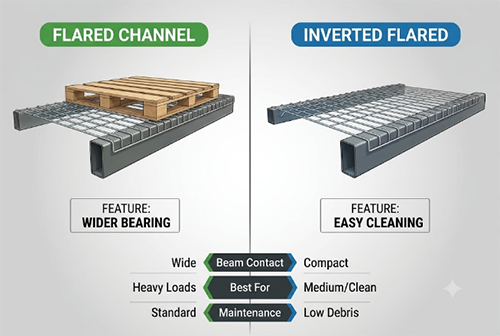
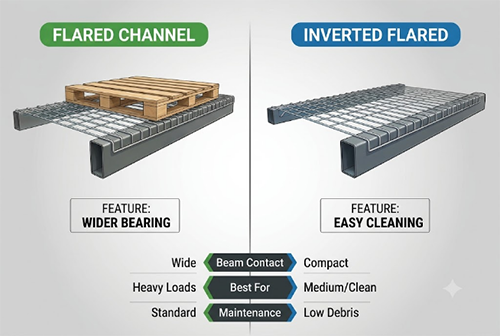
A Flared Channel design uses outward-angled support channels that engage more surface area with the pallet rack step beam. This structure can provide a wider bearing area between the decking and beam, helping distribute pallet loads more evenly under frequent loading conditions.
An Inverted Flared channel uses an inward-folded profile with the opening facing downward. This creates a compact support structure while maintaining reliable performance for many medium-duty pallet storage applications.
Although both designs are commonly manufactured using similar steel wire materials, such as 3–5 mm welded wire and galvanized support channels, their structural geometry affects how forces are transferred from pallets to rack beams.
For warehouses with frequent forklift operations and continuous pallet movement, the additional beam engagement provided by some Flared Channel designs can help improve deck stability over long-term use. For applications with lighter loads and lower handling frequency, Inverted Flared decking can provide an efficient and cost-effective solution.
2. Heavy-Duty Performance vs. Cost Efficiency
Although Flared Channel and Inverted Flared wire mesh decking can both be designed for heavy-duty pallet storage, they are often selected for different operating environments.
The actual load performance of wire decking depends on multiple factors, including deck dimensions, wire diameter, support channel quantity, beam compatibility, and the distribution of pallet loads. Therefore, the channel design should always be evaluated together with the overall rack configuration.
For warehouses handling heavy pallets with frequent forklift movement, a reinforced Flared Channel design is often preferred because the wider beam engagement can provide additional stability during repeated loading and unloading cycles.
For example, a beverage distribution center storing palletized products weighing around 1,000–1,200 kg and operating multiple forklift shifts per day requires wire decking that can withstand continuous impact and loading conditions. In this type of environment, many operators choose heavy-duty Flared Channel decking to improve long-term reliability.
On the other hand, warehouses storing lighter products with lower pallet turnover may not require the additional structural reinforcement. An Inverted Flared wire deck can provide dependable pallet support while helping control overall project costs.
For large-scale warehouse projects involving thousands of pallet rack levels, selecting the appropriate decking design can significantly influence the total investment without sacrificing operational safety.
3. Selecting the Right Wire Decking for Your Warehouse Environment
The best wire mesh decking design depends on how your warehouse operates. Before selecting between Flared Channel and Inverted Flared decking, buyers should consider pallet weight, storage density, forklift frequency, environmental conditions, and budget requirements.
Flared Channel Wire Decking Is Commonly Used For:
- Distribution centers with high pallet turnover
- Third-party logistics (3PL) warehouses
- Manufacturing facilities with continuous material handling
- Food and beverage storage operations
- Heavy pallet applications requiring frequent forklift access
- High-density pallet storage environments
These applications typically experience frequent pallet movement, where stable deck positioning and reliable load transfer are important factors for long-term rack performance.
Inverted Flared Wire Decking Is Commonly Used For:
- Retail distribution warehouses
- E-commerce fulfillment centers
- Spare parts storage facilities
- General industrial warehouses
- Medium-duty pallet storage applications
- Clean storage environments
One additional advantage of the Inverted Flared design is easier maintenance. Because the channel opening faces downward, dust, debris, and contaminants are less likely to collect inside the support channel, making routine cleaning easier in certain warehouse environments.
This characteristic makes Inverted Flared decking suitable for applications where cleanliness and easy maintenance are important considerations.
4. Key Factors Before Choosing Wire Mesh Decking
Selecting the right wire decking is not only about comparing Flared Channel and Inverted Flared designs. Warehouse operators should also evaluate several practical factors before making a purchasing decision.
Pallet Weight and Load Requirements
The expected pallet load is one of the most important factors when selecting wire mesh decking. Heavy pallets require reinforced wire structures, suitable support channels, and proper load distribution across rack beams.
Forklift Traffic Frequency
Warehouses with frequent pallet loading and unloading experience more repeated impact forces. In these environments, selecting a decking design with stronger beam engagement can help improve long-term stability.
Pallet Type and Condition
Wooden pallets, plastic pallets, and steel pallets have different support requirements. The mesh opening size and decking structure should be selected according to pallet dimensions and bottom support design.
Warehouse Environment
Cold storage, food facilities, and clean environments may require decking designs that are easier to maintain and clean, while general industrial warehouses may prioritize load performance and cost efficiency.
Flared Channel vs. Inverted Flared Wire Mesh Decking Comparison
| Feature | Flared Channel | Inverted Flared | Practical Consideration |
| Channel Design | Outward-flared support channel | Inward-folded support channel | Different structures affect beam engagement and load transfer |
| Beam Contact | Generally provides wider beam engagement | Compact support profile | Choose according to pallet weight and handling frequency |
| Heavy-Duty Applications | Common choice for frequent heavy pallet handling | Suitable for many medium-duty applications | Operating conditions are more important than design alone |
| Maintenance | Standard maintenance requirements | Downward-facing channel can reduce debris accumulation | Important for clean storage environments |
| Project Cost | Usually selected for higher-duty applications | Often provides a cost-effective solution | Select performance based on actual warehouse needs |
Frequently Asked Questions
Is Flared Channel wire decking stronger than Inverted Flared decking?
Not necessarily. Both designs can be engineered for similar load capacities. The better choice depends on deck dimensions, pallet weight, forklift activity, and warehouse operating conditions.
Which wire decking is better for heavy-duty pallet racks?
For warehouses with frequent heavy pallet handling, Flared Channel decking is often preferred because certain designs provide stronger beam engagement and improved stability under repeated loading conditions.
Can both designs be used on selective pallet racking?
Yes. Both Flared Channel and Inverted Flared wire mesh decking are commonly designed for step beam pallet rack systems. Compatibility should be confirmed based on beam profile and rack specifications.
How do I choose the right wire mesh decking for my warehouse?
Consider pallet weight, pallet type, forklift frequency, rack beam design, storage environment, and project budget. A properly matched decking solution provides better performance and avoids unnecessary costs.
2. Heavy-Duty Performance vs. Cost Efficiency
Although Flared Channel and Inverted Flared wire mesh decking can both be engineered for heavy-duty pallet rack applications, they are commonly selected for different warehouse operating conditions.
The actual load performance of wire decking depends on multiple factors, including deck dimensions, wire diameter, support channel design, rack beam compatibility, and pallet load distribution. Therefore, the channel design should always be evaluated together with the complete pallet rack system.
For warehouses handling heavy pallets with frequent forklift operations, Flared Channel wire decking is often preferred because its support structure can provide stronger beam engagement and improved deck stability during repeated loading and unloading cycles.
For example, a beverage distribution center storing palletized products weighing around 1,000–1,200 kg and operating multiple forklift shifts per day requires pallet rack decking that can withstand continuous loading activity. In this environment, reinforced Flared Channel decking can provide additional stability for long-term warehouse operations.
By comparison, warehouses storing lighter products with lower pallet turnover may not require the additional reinforcement. An Inverted Flared wire deck can provide reliable pallet support while offering a more economical option for medium-duty storage applications.
For large warehouse projects involving thousands of pallet rack levels, selecting the correct wire decking design can help balance performance requirements and overall project investment.
3. Selecting the Right Wire Decking for Your Warehouse Environment
The best wire mesh decking solution depends on how your warehouse operates. Instead of choosing the strongest option available, buyers should consider pallet weight, forklift traffic, storage conditions, and project requirements.
Flared Channel Wire Decking Is Commonly Used For:
- Distribution centers with high pallet turnover
- Third-party logistics (3PL) warehouses
- Manufacturing facilities with frequent material handling
- Food and beverage distribution warehouses
- Heavy pallet storage applications
- Warehouses with continuous forklift loading activity
These environments usually experience frequent pallet movement, making load stability and reliable beam support important factors for long-term rack performance.
Inverted Flared Wire Decking Is Commonly Used For:
- Retail distribution warehouses
- E-commerce fulfillment centers
- Spare parts storage facilities
- General industrial warehouses
- Medium-duty pallet storage applications
- Clean storage environments
One additional advantage of the Inverted Flared design is easier maintenance. Because the support channel opening faces downward, dust, moisture, and debris are less likely to accumulate inside the channel, making routine cleaning easier in certain warehouse environments.
This characteristic makes Inverted Flared wire decking a practical choice for facilities where cleanliness and maintenance efficiency are important considerations.
4. Key Factors Before Choosing Wire Mesh Decking
Selecting the right wire decking is not only about comparing Flared Channel and Inverted Flared designs. Warehouse operators should also evaluate several practical factors before making a purchasing decision.
Pallet Weight and Load Requirements
The expected pallet load is one of the most important factors when selecting wire mesh decking. Heavy pallets require reinforced wire structures, suitable support channels, and proper load distribution across rack beams.
Forklift Traffic Frequency
Warehouses with frequent pallet loading and unloading experience more repeated impact forces. In these environments, selecting a decking design with stronger beam engagement can help improve long-term stability.
Pallet Type and Condition
Wooden pallets, plastic pallets, and steel pallets have different support requirements. The mesh opening size and decking structure should be selected according to pallet dimensions and bottom support design.
Warehouse Environment
Cold storage, food facilities, and clean environments may require decking designs that are easier to maintain and clean, while general industrial warehouses may prioritize load performance and cost efficiency.
Flared Channel vs. Inverted Flared Wire Mesh Decking Comparison
| Feature | Flared Channel | Inverted Flared | Practical Consideration |
| Channel Design | Outward-flared support channel | Inward-folded support channel | Different structures affect beam engagement and load transfer |
| Beam Contact | Generally provides wider beam engagement | Compact support profile | Choose according to pallet weight and handling frequency |
| Heavy-Duty Applications | Common choice for frequent heavy pallet handling | Suitable for many medium-duty applications | Operating conditions are more important than design alone |
| Maintenance | Standard maintenance requirements | Downward-facing channel can reduce debris accumulation | Important for clean storage environments |
| Project Cost | Usually selected for higher-duty applications | Often provides a cost-effective solution | Select performance based on actual warehouse needs |
Frequently Asked Questions
Is Flared Channel wire decking stronger than Inverted Flared decking?
Not necessarily. Both designs can be engineered for similar load capacities. The better choice depends on deck dimensions, pallet weight, forklift activity, and warehouse operating conditions.
Which wire decking is better for heavy-duty pallet racks?
For warehouses with frequent heavy pallet handling, Flared Channel decking is often preferred because certain designs provide stronger beam engagement and improved stability under repeated loading conditions.
Can both designs be used on selective pallet racking?
Yes. Both Flared Channel and Inverted Flared wire mesh decking are commonly designed for step beam pallet rack systems. Compatibility should be confirmed based on beam profile and rack specifications.
How do I choose the right wire mesh decking for my warehouse?
Consider pallet weight, pallet type, forklift frequency, rack beam design, storage environment, and project budget. A properly matched decking solution provides better performance and avoids unnecessary costs.
-
-
PRODUCTS
-
NEWS
-
Flared vs Inverted Flared Wire Decking for Pallet Racks
24 JUL 2026
-
Split vs Solid Posts in Boltless Rivet Shelving
22 JUL 2026
-
Understanding Pallet Rack Load Capacity
21 JUL 2026
-
Flared vs Inverted Flared Wire Decking for Pallet Racks
-
FOLLOW US
-


 link:
Spieth Medical
link:
Spieth Medical


 if you have questions or suggestions,please leave us a message,we will reply you as soon as we can



-

-
 +86 18006010205
 -
 +86 18006010205
 0
0