 [email protected]
 +86 18006010205



-
Spieth, Space solutionsMore Than 18 Years Manufacturing & Exporting
-
 Time:7/28/2026
 -
 Time:7/24/2026
 -
 Time:7/22/2026
 -
 Time:7/21/2026
 -
 Time:7/16/2026
-
 Tel : +86 18006010205
-
 E-mail : [email protected]
-
 Address : Tongan Park, Tongan District, Xiamen, China 361023
How to Choose the Right Wheels for Logistic Trolley Carts
 Time:7/28/2026
 7
7Choosing the right wheels is one of the most important decisions when selecting an industrial trolley cart. While many buyers focus on frame structure, steel thickness, and load capacity, the caster wheels directly determine the cart’s mobility, stability, noise level, and service life.
In warehouse and factory environments, unsuitable trolley wheels can increase pushing effort, create excessive noise, damage flooring, and shorten the working life of the equipment.
On the other hand, selecting the correct wheel material and caster structure can improve handling efficiency, reduce maintenance costs, and create a safer working environment.
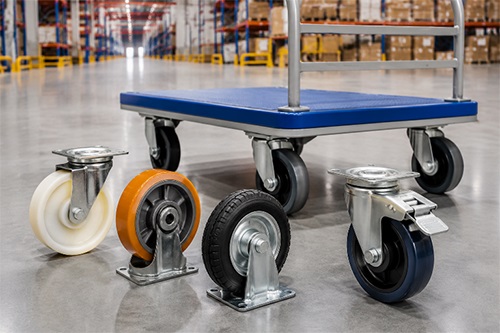
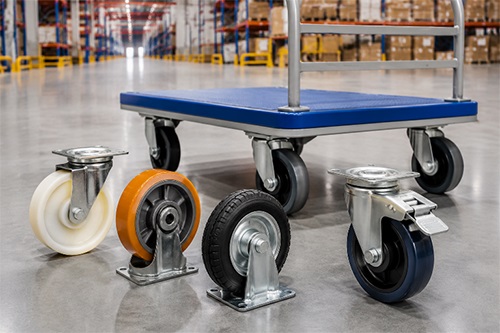
The most common industrial trolley wheel materials include PP (Polypropylene), PU (Polyurethane), and Rubber. Each material has different advantages in terms of hardness, rolling resistance, shock absorption, floor protection, and environmental adaptability.
This guide explains how to choose the right trolley wheels by comparing different wheel materials, caster structures, and application requirements.
What Factors Should You Consider When Choosing Trolley Wheels?
Before selecting wheels for an industrial warehouse trolley, buyers should evaluate several key factors including load capacity, floor conditions, operating frequency, and working environment.
1. Load Capacity
The wheel must safely support both the trolley weight and the maximum cargo load. Choosing wheels with insufficient capacity may lead to premature wear, bearing failure, or safety risks.
For heavy-duty material handling applications, selecting wheels with additional load capacity can improve durability and extend service life.
2. Floor Conditions
The working surface directly affects wheel performance. Different environments require different wheel materials.
| Floor Condition | Recommended Wheel Type |
|---|---|
| Smooth indoor floors | PU wheels provide excellent balance between durability, mobility, and floor protection. |
| Uneven floors or outdoor surfaces | Rubber wheels offer better shock absorption and traction. |
| Clean floors with light loads | PP wheels provide a cost-effective solution. |
3. Noise Requirements
In environments such as pharmaceutical warehouses, food processing facilities, hospitals, and retail stores, low-noise operation is often an important requirement.
Softer wheel materials generally absorb vibration better and reduce operating noise. This makes PU and rubber wheels suitable choices for applications where workplace comfort and product protection are important.
4. Frequency of Use
A trolley used occasionally in a storage area requires different wheels compared with a cart operating continuously on a production line.
For high-frequency material handling operations, investing in durable caster wheels can reduce replacement frequency and improve long-term operating efficiency.
PP vs PU vs Rubber Wheels: Material Comparison
The wheel material directly affects the performance of an industrial trolley cart. Different materials provide different advantages in terms of durability, noise control, load capacity, and environmental adaptability.
The three most common industrial caster wheel materials are PP (Polypropylene), PU (Polyurethane), and Rubber.
| Feature | PP Wheels | PU Wheels | Rubber Wheels |
|---|---|---|---|
| Hardness | High | Medium | Low |
| Rolling Resistance | Low for light loads | Excellent | Medium |
| Shock Absorption | Poor | Good | Excellent |
| Noise Level | Higher | Low | Lowest |
| Floor Protection | Limited | Good | Excellent |
| Outdoor Performance | Poor | Moderate | Excellent |
| Cost Level | Lowest | Medium | Higher |
1. PP Wheels (Polypropylene Wheels)
PP wheels are one of the most economical caster wheel options for light-duty industrial carts. Made from rigid polypropylene material, they provide good wear resistance and low rolling resistance under clean and smooth operating conditions.
Advantages of PP Wheels
- Low purchase cost and economical solution
- Lightweight and easy to maintain
- Good chemical resistance
- Suitable for clean indoor environments
Limitations of PP Wheels
Because polypropylene is a hard material, PP wheels provide limited shock absorption.
On uneven concrete floors or surfaces with debris, PP wheels may:
- Create more vibration
- Generate higher operating noise
- Transfer impact directly to transported goods
PP wheels are generally recommended for:
- Light-duty warehouse carts
- Picking carts
- Indoor storage areas with smooth flooring
2. PU Wheels (Polyurethane Wheels)
PU wheels are one of the most widely used caster wheel solutions for warehouse and factory trolley carts because they provide an excellent balance between durability, mobility, and floor protection.
With a typical Shore A hardness range of around 80-95, polyurethane wheels are softer than PP wheels while maintaining excellent wear resistance.
Advantages of PU Wheels
- Smooth and quiet operation
- Lower rolling resistance than rubber wheels
- Good load-bearing performance
- Protects warehouse floors from damage
- Suitable for frequent daily handling operations
PU wheels perform especially well in:
- Warehouses
- Factories
- Distribution centers
- Supermarkets
- Workshops
Limitations of PU Wheels
Although PU wheels provide excellent indoor performance, they may have limitations in:
- Extremely cold environments
- Long-term water exposure
- Rough outdoor surfaces
3. Rubber Wheels (High Elasticity Rubber Wheels)
Rubber wheels are widely used in applications where shock absorption, quiet operation, and surface adaptability are more important than maximum wear resistance.
Compared with PP and PU wheels, rubber wheels have a softer tread surface that absorbs vibration and reduces impact during transportation. This makes them suitable for environments where protecting goods and improving operator comfort are important.
Advantages of Rubber Wheels
- Excellent shock absorption performance
- Lowest operating noise among common wheel materials
- Better grip on uneven surfaces
- Suitable for outdoor applications
- Good adaptability in temperature-sensitive environments
Rubber wheels are commonly used for:
- Outdoor material handling
- Construction sites
- Uneven factory floors
- Cold storage environments
- Applications requiring quiet operation
For example, when transporting fragile products such as glass containers, precision components, or sensitive equipment, rubber wheels can reduce vibration and improve load stability.
Limitations of Rubber Wheels
The softer rubber tread also creates some disadvantages:
- Higher rolling resistance compared with PU wheels
- Faster wear on high-abrasion industrial floors
- Usually higher cost than PP and PU wheels
Therefore, rubber wheels are not always the best choice for every warehouse application. They are most suitable when shock absorption, traction, and terrain adaptability are the main priorities.
Fixed, Swivel, or Brake Casters: Choosing the Right Wheel Structure
Besides wheel material, the caster structure also plays an important role in trolley performance. The right caster design affects movement direction, maneuverability, safety, and operator efficiency.
The three most common industrial caster structures include: fixed casters, swivel casters, and brake casters.
| Caster Type | Main Feature | Recommended Applications |
|---|---|---|
| Fixed Casters | Move only forward and backward with excellent stability | Straight warehouse aisles, production lines, long-distance transportation |
| Swivel Casters | Rotate 360 degrees for flexible movement | Warehouses with limited space, workshops, supermarkets |
| Brake Casters | Lock the wheel to prevent unwanted movement | Loading areas, ramps, medical facilities, precision handling |
Fixed Casters
Fixed casters are designed for straight-line transportation. Since the wheel direction remains fixed, they provide excellent stability and lower rolling resistance.
Advantages:
- High stability during movement
- Easy control on straight routes
- Suitable for heavy loads
Recommended applications:
- Warehouse aisles
- Production lines
- Long-distance material transportation
Swivel Casters
Swivel casters can rotate 360 degrees, allowing trolley carts to move in multiple directions. They are ideal for environments where flexibility and maneuverability are important.
Advantages:
- Better maneuverability
- Easier turning in narrow spaces
- Improved operational flexibility
Recommended applications:
- Warehouses with limited aisle space
- Workshops
- Retail stores
- Loading areas
Brake Casters
Brake casters include a locking mechanism that prevents the trolley from moving during loading, unloading, or temporary parking.
Advantages:
- Improves workplace safety
- Prevents movement on slopes
- Provides better control during operation
Brake casters are recommended for:
- Ramps
- Loading and unloading areas
- Medical facilities
- Precision equipment handling
Other Specifications to Check Before Buying Trolley Wheels
Besides wheel material and caster structure, several technical specifications also affect the performance and service life of industrial trolley wheels.
When selecting caster wheels for warehouse carts, buyers should also consider:
- Wheel diameter
- Bearing type
- Caster mounting method
- Operating environment
1. Wheel Diameter Selection
The wheel diameter directly affects pushing effort, obstacle crossing ability, and trolley stability.
Generally, larger wheels provide easier movement, especially on uneven floors or when transporting heavy loads.
| Wheel Diameter | Recommended Application |
|---|---|
| 75-100 mm | Light-duty warehouse carts, picking carts, short-distance movement |
| 125-160 mm | General industrial trolley carts, factories, warehouses |
| 200 mm and above | Heavy-duty handling, uneven floors, outdoor applications |
2. Bearing Type Selection
The bearing system inside the caster wheel affects rolling smoothness, load capacity, and maintenance requirements.
| Bearing Type | Features | Suitable Applications |
|---|---|---|
| Plain Bearing | Simple structure, economical, suitable for low-speed applications | Light-duty carts and occasional use |
| Roller Bearing | Good load capacity and durability | Industrial warehouses and factories |
| Ball Bearing | Smooth movement and lower rolling resistance | Frequent handling and high-efficiency applications |
For frequently used warehouse trolley carts, choosing high-quality bearings can significantly improve movement efficiency and reduce operator fatigue.
3. Caster Mounting Types
The mounting method determines how the caster wheel is connected to the trolley frame. The most common mounting options include plate casters and stem casters.
| Mounting Type | Characteristics | Applications |
|---|---|---|
| Plate Caster | Strong connection with high load capacity | Industrial trolley carts, platform carts, heavy-duty equipment |
| Stem Caster | Compact installation and flexible mounting | Light equipment, mobile racks, small carts |
For industrial logistics trolley carts handling heavier loads, plate-mounted casters are usually preferred because they provide better stability and load distribution.
How to Choose the Right Trolley Wheels for Different Applications?
| Application | Recommended Wheel Type | Reason |
|---|---|---|
| Warehouse picking carts | PU or PP wheels | Light movement, low noise, smooth floors |
| Factory material handling | PU wheels with roller or ball bearings | Frequent use and durability requirements |
| Outdoor transportation | Rubber wheels | Better shock absorption and surface adaptability |
| Supermarket and retail applications | PU swivel casters | Quiet operation and easy maneuverability |
How to Extend the Service Life of Trolley Wheels
Even high-quality industrial trolley wheels require proper maintenance to achieve maximum service life. Regular inspection and correct usage can help reduce replacement costs and improve workplace safety.
1. Clean Wheels Regularly
Dust, metal chips, packaging materials, and debris can accumulate around the wheel axle and increase rolling resistance.
Regular cleaning helps maintain smooth movement and prevents unnecessary wear on bearings and wheel surfaces.
2. Avoid Overloading the Trolley
Exceeding the recommended load capacity is one of the most common causes of premature wheel failure.
Overloading may result in:
- Wheel deformation
- Bearing damage
- Caster frame bending
- Reduced service life
Always select wheels based on the maximum operating load rather than the average daily load.
3. Inspect Wheel Condition Regularly
Routine inspection helps identify problems before they affect safety and operation.
Check for:
- Cracks or surface damage
- Uneven wheel wear
- Loose bearings
- Damaged brake mechanisms
- Abnormal noise during movement
Replacing damaged wheels at an early stage can prevent equipment downtime and improve workplace safety.
4. Match Wheel Material with the Working Environment
Using the wrong wheel type is one of the main reasons for premature failure.
| Wrong Selection | Possible Result |
|---|---|
| PP wheels used on rough outdoor surfaces | Higher vibration and possible cracking |
| PU wheels used in extreme environments | Material degradation and reduced performance |
| Rubber wheels used on highly abrasive floors | Faster tread wear |
PP vs PU vs Rubber Wheels: Which One Should You Choose?
The best trolley wheel type depends on the actual working environment, not simply the highest-priced option.
| Choose | When You Need | Typical Applications |
|---|---|---|
| PP Wheels | Low cost, light loads, smooth indoor floors | Storage areas, light-duty carts, occasional movement |
| PU Wheels | Daily operation, durability, low noise, floor protection | Warehouses, factories, distribution centers, supermarkets |
| Rubber Wheels | Shock absorption, outdoor use, uneven surfaces | Construction sites, outdoor warehouses, fragile goods handling |
Frequently Asked Questions About Trolley Wheels
Which trolley wheels are best for warehouse use?
For most warehouse applications, PU wheels are the preferred choice because they provide a good balance of load capacity, durability, smooth movement, and low operating noise on concrete or epoxy floors.
Are PU wheels better than rubber wheels?
It depends on the working environment. PU wheels are usually better for indoor warehouses because they offer lower rolling resistance and higher wear resistance. Rubber wheels are more suitable for outdoor areas and uneven surfaces because they provide better shock absorption.
What is the difference between PP and PU wheels?
PP wheels are harder, more economical, and suitable for light-duty applications. PU wheels are softer, quieter, and provide better durability for frequent industrial use.
How many caster wheels should a trolley cart have?
Most industrial trolley carts use four caster wheels. The required wheel capacity should be calculated based on the total trolley weight, maximum load, and an appropriate safety factor.
Can trolley wheels be replaced?
Yes. Most industrial trolley wheels are replaceable. When replacing wheels, make sure the new caster matches the required load capacity, mounting size, wheel diameter, and operating environment.
Conclusion: Select Wheels Based on Your Application
Choosing the right wheels for a logistics trolley cart is not simply about selecting the cheapest or strongest option. The ideal wheel depends on:
- Load capacity requirements
- Floor conditions
- Operating frequency
- Noise requirements
- Transportation environment
For most indoor warehouse and factory applications, PU wheels are the most balanced solution, offering smooth operation, durability, and low noise performance.
For light-duty applications with cost considerations, PP wheels provide a practical and economical option.
For outdoor environments, uneven surfaces, cold conditions, or applicatidons requiring maximum shock absorption, rubber wheels offer better adaptability.
Need the Right Trolley Wheel Solution?
Spieth provides industrial material handling solutions designed for warehouses, factories, and commercial environments. Our team can help select suitable trolley configurations based on load requirements, working conditions, and application needs.
Contact Spieth for professional recommendations on industrial trolley carts and caster wheel solutions.
-
-
PRODUCTS
-
NEWS
-
FOLLOW US
-


 link:
Spieth Medical
link:
Spieth Medical


 if you have questions or suggestions,please leave us a message,we will reply you as soon as we can



-

-
 +86 18006010205
 -
 +86 18006010205
 0
0