 [email protected]
 +86 18006010205



-
Spieth, Space solutionsMore Than 18 Years Manufacturing & Exporting
-
 Time:6/1/2026
 -
 Time:5/26/2026
 -
 Time:5/21/2026


-
 Tel : +86 18006010205
-
 E-mail : [email protected]
-
 Address : Tongan Park, Tongan District, Xiamen, China 361023
What Does UDL Mean in Racking
 Time:5/26/2026
 48
48What Does UDL Mean in Racking? Complete Guide to Warehouse Load Safety & Structural Design
Industrial warehouse engineering guide for pallet racking load distribution, safety standards, and structural optimization
In warehouse racking systems, load capacity is one of the most critical engineering parameters affecting safety, efficiency, and long-term structural stability. However, many operators only focus on the numerical load rating without understanding how that load is defined and applied in real-world conditions.
One of the most important engineering concepts used in racking design is UDL (Uniformly Distributed Load), which defines how weight should be distributed across beams and shelving levels to ensure safe operation.
Misunderstanding UDL can lead to improper loading behavior, beam deflection, and even structural failure in industrial warehouse environments.
What Does UDL Mean in Racking?
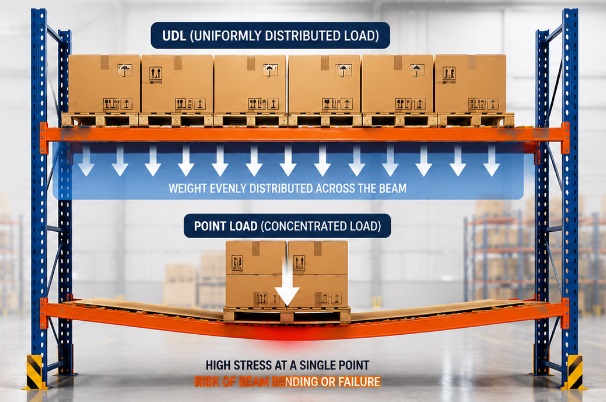
UDL (Uniformly Distributed Load) refers to a load that is evenly spread across the entire beam or racking level. In warehouse applications, it means the total weight placed on a beam is distributed uniformly rather than concentrated at a single point.
For example, if a pallet racking beam is rated for 1000 kg UDL per level, the total load on that level must not exceed 1000 kg, and the load should be evenly distributed across the beam span.
This is the standard engineering assumption used in designing pallet racking systems, wire decking systems, and industrial shelving structures.
UDL Load Distribution Concept (Industrial Diagram)
The diagram above illustrates how load is evenly distributed across a racking beam, which is the fundamental principle of UDL-based structural design.
Related Warehouse Racking Systems
Explore other industrial storage solutions that follow UDL engineering principles:
• Pallet Racking System – Heavy-duty storage designed for palletized goods
• Wire Mesh Decking – Improves load distribution and safety
• Drive-in Racking System – High-density storage solution for bulk goods
UDL vs Point Load in Warehouse Racking
In real warehouse operations, one of the most common safety misunderstandings is the difference between UDL (Uniformly Distributed Load) and point load conditions. While UDL assumes weight is spread evenly across a beam, point load refers to concentrated weight applied at a single location.
This difference is critical because racking systems are primarily designed and tested under UDL assumptions. When loads are not evenly distributed, structural stress increases significantly at specific points, which may lead to beam deformation or even structural failure over time.
| Aspect | UDL (Uniform Load) | Point Load |
|---|---|---|
| Load Distribution | Evenly spread across beam | Concentrated at single point |
| Structural Stress | Low and balanced | High localized stress |
| Safety Level | Higher stability | Higher risk of deformation |
| Typical Use | Pallet racking, shelving, decking | Heavy machinery, irregular loads |
How UDL Applies in Real Warehouse Operations
Although UDL is an engineering concept, it is directly reflected in everyday warehouse storage practices. Most industrial storage systems are designed to naturally achieve uniform load distribution through proper palletization and storage planning.
1. Pallet Racking Systems: Goods are placed on pallets that distribute weight evenly across beam spans, aligning with UDL assumptions.
2. Wire Mesh Decking Systems: Small cartons and irregular items are spread across decking surfaces, ensuring balanced weight distribution.
3. Industrial Shelving Systems: Multiple small containers placed across shelves naturally create uniform loading conditions.
Common Mistakes in UDL Load Management
Even in professionally managed warehouses, improper understanding of load distribution can lead to unsafe conditions and reduced racking lifespan.
One of the most common mistakes is placing heavy items in a single position on the beam instead of distributing them evenly across the rack level.
Typical mistakes include:
• Concentrating heavy pallets at the center of the beam
• Overloading one side of the rack level
• Ignoring pallet dimensions relative to beam span
• Misreading load capacity labels as total allowable weight without distribution rules
How to Read Warehouse Load Capacity Labels
Warehouse racking systems typically display load ratings in terms of UDL per level, upright frame capacity, and total system load. Among these, UDL per level is the most critical value for daily operations.
Understanding these labels correctly ensures that operators do not exceed safe loading conditions and maintain proper weight distribution across each beam level.
In practical terms, this means ensuring that no single pallet or item exceeds the structural design assumptions of even load distribution.
Structural Engineering Insight Behind UDL
In warehouse racking engineering, UDL is not only a simplified loading assumption but also a fundamental basis for evaluating beam behavior under stress. When load is evenly distributed, the bending moment along the beam becomes predictable and stable, allowing engineers to design safe and efficient storage structures.
However, in real warehouse environments, perfect uniformity rarely exists. That is why structural engineers apply safety factors to account for dynamic conditions such as forklift vibration, uneven pallet placement, and sudden impact during loading operations.
Beam Performance & Load Behavior in Real Conditions
Under continuous warehouse operation, racking beams experience both static and dynamic loads. Static load refers to stored goods, while dynamic load includes forklift placement, pallet sliding, and operational vibration.
When load distribution deviates from UDL conditions, stress concentration increases at specific points, which may lead to gradual beam deflection or connector fatigue over time.
Early signs of structural stress include visible beam bending, coating cracks at connection points, and slight misalignment between upright frames.
Warehouse Racking Safety Inspection Checklist
Regular inspection of warehouse racking systems is essential to ensure long-term operational safety and prevent structural failure.
Daily / Weekly inspection points:
• Check beam alignment for visible deflection or bending
• Inspect upright frames for impact damage from forklifts
• Verify pallet placement consistency and load balance
• Check for loose connectors, bolts, or locking pins
• Look for coating damage that may indicate structural stress
Why UDL Principle Still Matters in Real Warehouses
Even though warehouse operations are rarely perfectly uniform, the UDL model remains essential because it provides a safe engineering baseline for structural design.
Without UDL-based design, racking systems would need to be over-engineered for unpredictable load conditions, significantly increasing cost and reducing storage efficiency.
Therefore, UDL serves as the balance between engineering safety and economic efficiency in modern warehouse storage systems.
Need Engineering-Level Racking Design Support?
Get professional warehouse racking solutions based on UDL calculations, structural safety analysis, and customized layout engineering.
-
-
PRODUCTS
-
NEWS
-
What Is Slotting in a Warehouse
01 JUN 2026
-
Why USA Customers Prefer Importing Heavy Duty Flower Carts from China
29 MAY 2026
-
What Does UDL Mean in Racking
26 MAY 2026
-
What Is Slotting in a Warehouse
-
FOLLOW US
-


 link:
Spieth Medical
link:
Spieth Medical


 if you have questions or suggestions,please leave us a message,we will reply you as soon as we can



-

-
 +86 18006010205
 -
 +86 18006010205
 0
0