 [email protected]
 +86 18006010205



-
Spieth, Space solutionsMore Than 18 Years Manufacturing & Exporting
-
 Time:6/1/2026
 -
 Time:5/26/2026
 -
 Time:5/21/2026
-
 Tel : +86 18006010205
-
 E-mail : [email protected]
-
 Address : Tongan Park, Tongan District, Xiamen, China 361023
What Is Slotting in a Warehouse
 Time:6/1/2026
 25
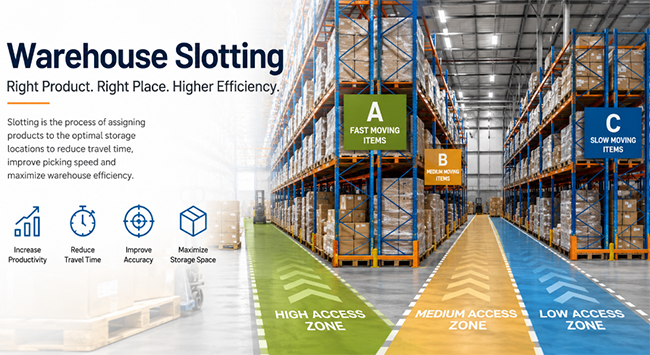
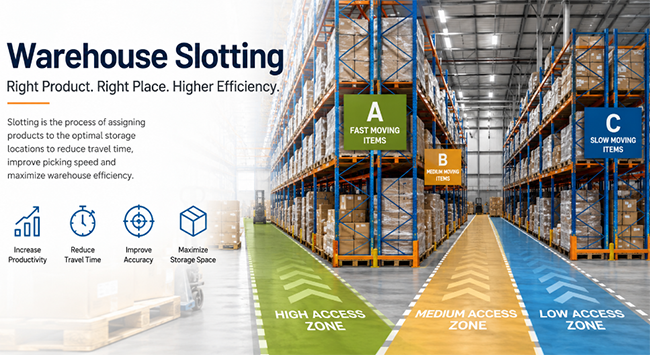
25Warehouse slotting is the process of assigning inventory to specific storage locations inside a warehouse based on product demand, picking frequency, size, weight, and order patterns.
The goal of slotting is not only to organize products, but to optimize warehouse flow, reduce travel time, and improve overall picking efficiency.
In modern logistics operations, warehouse slotting is a key part of warehouse optimization and inventory control strategy, especially in e-commerce, retail distribution, and 3PL environments.
Why Warehouse Slotting Is Important
Warehouse efficiency is not determined only by space, but by how inventory is positioned.
Poor slotting leads to:
- Excessive picker travel distance
- Congested aisles
- Slower order fulfillment
- Higher labor cost per order
- Increased picking errors
In many warehouses, picking and travel activities can account for a significant portion of total labor time. Even small improvements in slotting strategy can lead to measurable operational gains.
A well-designed slotting system helps warehouses:
- Reduce unnecessary movement inside aisles
- Improve order picking speed
- Increase storage density utilization
- Support faster order processing
- Improve workforce productivity
- Stabilize warehouse operations during peak demand
How Warehouse Slotting Works
Warehouse slotting is a data-driven process. It relies on analyzing SKU behavior and assigning optimal storage locations accordingly.
The process typically includes the following steps:
1. SKU Data Collection
Warehouses collect data such as:
- Order frequency
- Sales velocity
- Unit size and weight
- Order combinations
- Seasonal demand patterns
2. SKU Classification
Products are grouped based on importance or movement speed.
The most common method is ABC classification:
- A Items → High frequency, high priority SKUs
- B Items → Medium demand SKUs
- C Items → Low movement SKUs
3. Location Assignment
After classification, storage locations are assigned:
- A items → closest to picking and shipping areas
- B items → mid-range warehouse zones
- C items → upper levels or deeper storage zones
4. Continuous Optimization
Slotting is not a one-time process. It must be adjusted based on:
- Seasonal demand changes
- New product introduction
- Sales pattern shifts
- Warehouse layout changes
This process is often referred to as warehouse slotting optimization.
Warehouse Slotting Optimization (Advanced Concept)
Warehouse slotting optimization focuses on continuously improving product placement to maximize efficiency and reduce operational cost.
Unlike basic slotting, optimization considers:
- Travel path distance reduction
- Order batching efficiency
- Slotting reconfiguration frequency
- Warehouse congestion points
- Labor productivity per zone
Advanced warehouses use Warehouse Management Systems (WMS) to automate slotting decisions based on real-time data.
The result is a dynamic warehouse where inventory locations are continuously adjusted to match demand behavior.
Common Warehouse Slotting Strategies
Different warehouses apply different slotting strategies depending on their operational model.
ABC Slotting
ABC slotting is the most widely used method.
It prioritizes inventory based on demand:
- A items: placed in the most accessible “golden zone”
- B items: moderate accessibility areas
- C items: low-access or reserve storage areas
This method significantly reduces picker travel time in high-volume warehouses.
Velocity-Based Slotting
Velocity slotting organizes products based on movement speed rather than static classification.
Fast-moving products are placed in high-access zones, ensuring continuous replenishment efficiency.
Family-Based Slotting
Products that are frequently ordered together are stored close to each other.
This reduces multi-location picking and improves order consolidation efficiency.
Typical examples:
- Packaging materials
- Spare parts kits
- Retail accessory bundles
Forward Pick Slotting
Forward pick areas are dedicated fast-picking zones where high-demand SKUs are stored in smaller quantities.
Bulk inventory is stored in reserve racks, and replenished into forward pick zones when needed.
This is widely used in e-commerce fulfillment centers.
Warehouse Slotting Optimization Example
Consider a warehouse managing 8,000 SKUs with high daily order volume.
Before optimization:
- Fast-moving products were distributed randomly
- Pickers traveled long distances per order
- High congestion occurred in central aisles
- Order processing time was inconsistent
After slotting optimization:
- High-demand SKUs were relocated to forward pick zones
- Related products were grouped together
- Reserve inventory was moved to upper rack levels
- A/B/C structure was clearly defined
Operational impact:
- Reduced picker travel distance
- Improved order fulfillment speed
- More stable warehouse flow
- Better space utilization across rack levels
How Warehouse Racking Systems Support Slotting
Warehouse slotting cannot be separated from storage infrastructure.
The type of racking system directly affects how efficiently slotting strategies can be executed.
Selective Pallet Racking
Selective pallet racking provides direct access to every pallet position.
It supports flexible slotting because:
- SKUs can be reassigned easily
- Fast movers can be relocated quickly
- Inventory can be reorganized without structural changes
This makes it ideal for dynamic SKU environments.
Carton Flow Racking
Carton flow systems use gravity rollers to ensure FIFO (first-in-first-out) movement.
They are highly effective for:
- Fast-moving consumer goods
- High-frequency picking operations
- E-commerce fulfillment
This system naturally supports velocity-based slotting.
Radio Shuttle Racking
Radio shuttle systems are designed for high-density pallet storage.
They improve slotting efficiency by:
- Reducing forklift travel distance
- Increasing storage density
- Supporting deep-lane SKU storage
This system is often used for bulk storage with structured slotting zones.
Mezzanine Storage Systems
Mezzanine structures expand vertical storage capacity without expanding warehouse footprint.
They help slotting by:
- Creating separate SKU zones
- Supporting multi-level classification
- Increasing forward pick capacity
Common Warehouse Slotting Mistakes
Even advanced warehouses can lose efficiency due to poor slotting decisions.
Ignoring SKU velocity changes
Demand patterns change constantly. Static slotting reduces efficiency over time.
Over-prioritizing storage density
Maximizing space without considering picking flow often reduces productivity.
Lack of re-slotting strategy
Warehouses that do not re-slot periodically gradually lose efficiency.
Poor SKU association planning
Frequently ordered items stored far apart increase travel time significantly.
Warehouse Slotting KPIs
Warehouse slotting performance is measured using operational KPIs such as:
- Average picker travel distance
- Order picking rate per hour
- Labor cost per order
- Order accuracy rate
- Warehouse throughput
- Slot utilization efficiency
These KPIs are often tracked using WMS systems for continuous improvement.
Frequently Asked Questions
What is warehouse slotting?
Warehouse slotting is the process of assigning inventory to optimized storage locations based on demand, size, weight, and picking frequency to improve warehouse efficiency.
What is slotting optimization?
Slotting optimization is the continuous improvement of SKU placement based on real-time data to reduce travel time and increase warehouse productivity.
What is ABC slotting in a warehouse?
ABC slotting is a classification method that divides inventory into A, B, and C categories based on demand frequency to determine storage priority.
Is warehouse slotting part of inventory management?
Yes. Slotting is a sub-process of inventory management focused specifically on physical placement optimization inside warehouses.
How does slotting improve warehouse efficiency?
It reduces unnecessary movement, improves picking speed, and ensures high-demand products are placed in the most accessible locations.
Conclusion
Warehouse slotting is a critical strategy in modern warehouse operations that directly impacts efficiency, labor cost, and order fulfillment speed.
When combined with the right warehouse racking systems such as selective pallet racking, carton flow systems, and radio shuttle racking, slotting becomes a powerful optimization tool that improves both storage density and operational performance.
For warehouses aiming to scale efficiently, slotting is not optional—it is a core part of warehouse design and operational strategy.
-
-
PRODUCTS
-
NEWS
-
What Is Slotting in a Warehouse
01 JUN 2026
-
Why USA Customers Prefer Importing Heavy Duty Flower Carts from China
29 MAY 2026
-
What Does UDL Mean in Racking
26 MAY 2026
-
What Is Slotting in a Warehouse
-
FOLLOW US
-


 link:
Spieth Medical
link:
Spieth Medical


 if you have questions or suggestions,please leave us a message,we will reply you as soon as we can



-

-
 +86 18006010205
 -
 +86 18006010205
 0
0