 [email protected]
 +86 18006010205



-
Spieth, Space solutionsMore Than 18 Years Manufacturing & Exporting
-
 Time:6/17/2026
 -
 Time:6/15/2026
 -
 Time:6/11/2026
-
 Tel : +86 18006010205
-
 E-mail : [email protected]
-
 Address : Tongan Park, Tongan District, Xiamen, China 361023
Pallet and Racking System Safety Risks Explained
 Time:6/17/2026
 4
4
In industrial warehouse environments, pallet systems and racking structures form a tightly coupled engineering system. A failure in pallet integrity does not remain isolated — it propagates directly into racking instability, automation disruption, and large-scale operational risk.
Despite this, many warehouses still treat pallets as consumable materials rather than load-bearing engineering components.
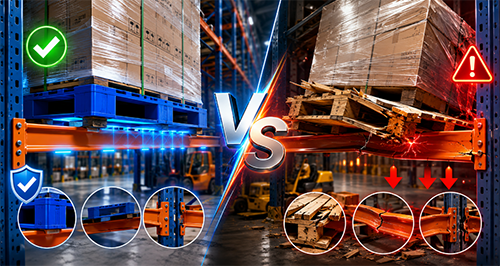
1. The Core Engineering Principle: Pallet as a Structural Load Interface
In racking systems, every stored unit load is transferred through the pallet before reaching beam structures. This creates a multi-stage load path:
Product → Pallet → Rack Beam → Upright Frame → Floor Load
Any weakness or deformation in the pallet disrupts this load chain, converting a uniformly distributed load (UDL) into unpredictable stress concentration points.
2. Structural Failure Mechanisms Caused by Substandard Pallets
The majority of rack-related incidents are not caused by design flaws in racking systems, but by deviations in pallet structural behavior under load.
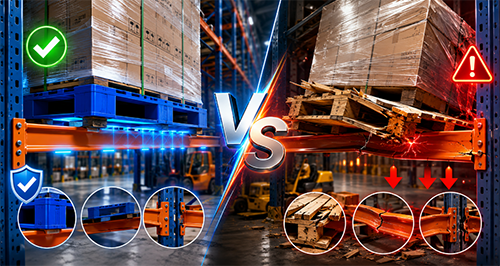
Low-quality pallets bend under load, creating uneven contact with rack beams. Instead of distributing weight evenly, the load shifts to localized beam points. This significantly accelerates fatigue failure in steel structures.
Repeated loading cycles cause incremental deformation in wooden or plastic pallets. Over time, this reduces effective load distribution and increases beam stress variance.
During forklift insertion or automated retrieval, weak pallet structures introduce vibration amplification, increasing the probability of product displacement or system misalignment.
3. Impact on Automated Warehousing Systems (AGV / ASRS)
Automation systems require strict dimensional and structural consistency. Even minor deviations in pallet geometry can cascade into system-level failures.
Common issues include:
✔ Sensor misreads due to uneven pallet height
✔ AGV docking misalignment (±5–10mm deviation critical)
✔ ASRS retrieval errors caused by pallet base deformation
✔ Conveyor blockage due to broken bottom boards
These engineering risks directly translate into measurable financial losses — which will be analyzed in the next section: Total Cost of Ownership (TCO) and real warehouse case study.
4. Total Cost of Ownership (TCO): The Real Financial Impact of Pallet Failure
Beyond structural safety, pallet quality directly influences long-term operational cost, labor efficiency, and warehouse uptime.
In large-scale distribution centers, pallet-related inefficiencies create compounding cost effects rather than isolated expenses.
Substandard pallets increase rack maintenance frequency by 12%–28% annually due to beam deformation and repeated impact stress.
Warehouse interruptions caused by pallet failure typically cost $2,000–$20,000 per hour depending on throughput scale.
Mixed or unstable pallets reduce picking efficiency by 15%–40% due to handling delays and rework cycles.
Structural instability increases product damage risk by up to 2–5×, especially in high-bay storage environments.
5. Engineering Case Study: Automated E-Commerce Fulfillment Warehouse
A high-throughput e-commerce fulfillment center operating AS/RS + AGV systems experienced recurring picking failures and rack vibration anomalies.
The facility handled over 80,000 order lines per day, making even minor inefficiencies highly impactful on total throughput.
Initial Symptoms:
- Frequent AGV docking misalignment
- Intermittent ASRS retrieval errors
- Visible pallet bottom board cracking in selective racking zones
Root Cause Analysis: Mixed pallet fleet (low-grade wooden + non-reinforced plastic pallets) with inconsistent bottom deck geometry.
Engineering Intervention:
- Standardized rackable pallet design with reinforced 3-runner structure
- Unified pallet dimensional tolerance control (±3mm)
- Introduced pallet entry inspection protocol (Go / No-Go system)
Final Results:
✔ 92% reduction in handling errors
✔ 37% improvement in picking cycle efficiency
✔ Significant reduction in AGV misalignment incidents
✔ Stabilized rack load distribution across all zones
6. Engineering Insight: Why Small Deviations Create System-Level Failure
Modern warehouse systems operate under high-density constraints where tolerances are extremely narrow.
A seemingly minor pallet deviation (5–10mm) can trigger:
✔ Structural misalignment across multi-tier racking
✔ Cumulative vibration amplification in automated systems
✔ Increased beam fatigue due to uneven load transfer
✔ System-wide reduction in operational reliability
The next section will translate these engineering and financial risks into a decision framework for pallet selection and system upgrade strategy.
7. Engineering Decision Matrix: Selecting the Right Pallet for Racking Systems
Different warehouse environments require different pallet structural performance levels. Incorrect selection is one of the leading causes of racking inefficiency and failure.
| Warehouse Scenario | Recommended Pallet Type | Engineering Requirement |
|---|---|---|
| General Storage / Selective Racking | Reinforced Wooden Pallet | Hardwood structure, anti-deflection bottom support |
| Cold Storage / High Humidity | Rackable Plastic Pallet | Steel-reinforced runners, anti-creep design |
| Heavy Industry / Steel Coil Storage | Steel Pallet | High load capacity, rack beam load recalculation required |
| Export / One-Way Logistics | Paper / Lightweight Pallet | Requires external support (decking or flat base system) |
8. Standard vs Engineering-Grade Pallet Systems
9. Frequently Asked Engineering Questions (FAQ)
No. Only rackable pallets with proper bottom deck support are safe for beam-supported storage systems.
Beam point loading, which significantly increases the risk of structural deformation and rack failure.
Yes. AGV and ASRS systems require strict dimensional tolerance and stable pallet geometry for reliable operation.
In high-intensity warehouses, pallet inspection should be performed before every entry into racking zones.
Request a Complete Pallet–Racking System Engineering Solution
Aceally provides integrated warehouse engineering support including racking design, pallet compatibility analysis, and load optimization strategy.
Designed for logistics centers, cold storage facilities, manufacturing warehouses, and automated distribution systems.
-
-
PRODUCTS
-
NEWS
-
FOLLOW US
-


 link:
Spieth Medical
link:
Spieth Medical


 if you have questions or suggestions,please leave us a message,we will reply you as soon as we can



-

-
 +86 18006010205
 -
 +86 18006010205
 0
0