 [email protected]
 +86 18006010205



-
Spieth, Space solutionsMore Than 18 Years Manufacturing & Exporting
-
 Time:6/24/2026
 -
 Time:6/23/2026
 -
 Time:6/17/2026
 -
 Time:6/15/2026
-
 Tel : +86 18006010205
-
 E-mail : [email protected]
-
 Address : Tongan Park, Tongan District, Xiamen, China 361023
Warehouse Racking Inspection Checklist: Safety Guide
 Time:6/24/2026
 6
6Warehouse racking systems are one of the most critical structural components in modern logistics, manufacturing, and distribution environments. They support heavy palletized loads, operate under continuous forklift traffic, and function in dynamic environments where mechanical impact, uneven loading, and long-term fatigue stress are unavoidable.
Unlike static construction structures, pallet racking systems are constantly exposed to repeated low-energy impacts that accumulate over time. These micro-impacts do not immediately cause collapse, but they gradually weaken structural integrity, leading to progressive deformation and eventual system failure.
Structural failure in warehouse racking systems is not sudden. It is the final stage of cumulative damage caused by repeated forklift impact, load imbalance, and unnoticed deformation.
1. Introduction to Warehouse Racking Inspection Systems
A warehouse racking inspection system is a structured engineering methodology used to evaluate the safety, stability, and load-bearing condition of pallet racking structures. It is not a simple visual check, but a multi-level technical assessment that identifies both visible damage and hidden structural risks.
In real warehouse environments, most structural failures occur due to a combination of unnoticed damage and operational negligence rather than a single catastrophic event. Forklift operators may accidentally impact upright frames, pallets may be overloaded beyond rated capacity, and anchor bolts may gradually loosen over time due to vibration cycles.
Without a standardized inspection system, these risks accumulate silently until a critical failure occurs, often resulting in inventory loss, operational downtime, and safety hazards.
2. Why Warehouse Racking Inspection Is Critical for Safety
Warehouse racking systems operate under continuous mechanical stress. Unlike passive storage structures, they must withstand dynamic forklift movements, repeated loading cycles, and constant vibration from warehouse operations.
The most dangerous aspect of racking failure is not immediate collapse, but hidden structural degradation. A rack may appear stable externally while internal stress redistribution has already weakened its load-bearing capacity.
Over 70% of rack failures begin with undetected upright or beam deformation caused by repeated low-level forklift impact.
Common risk factors include:
- Forklift collision with upright frames
- Overloaded beam levels exceeding design capacity
- Missing or loose anchor bolts at base connections
- Uneven pallet load distribution across beam levels
- Long-term fatigue stress in high-cycle environments
3. Engineering Failure Mechanism in Racking Systems
To understand warehouse racking inspection properly, it is necessary to understand how structural failure develops in engineered steel racking systems.
Failure does not occur at the moment of impact. Instead, it follows a progressive degradation cycle where stress is redistributed across the structure after each damage event.
Forklift impact → Micro-deformation → Load redistribution → Beam stress increase → Fatigue accumulation → Structural instability → Collapse
Once an upright column is slightly deformed, it no longer distributes vertical loads evenly. This causes additional stress to shift toward adjacent beams and connectors, accelerating fatigue in surrounding components.
Over time, this creates a cascading effect where localized damage evolves into system-wide instability.
4. Multi-Level Inspection Philosophy
Effective warehouse safety management requires a layered inspection strategy rather than a single periodic check. Each level of inspection targets different types of risk exposure and structural degradation.
Level 2: Weekly supervisory inspection (warehouse managers)
Level 3: Monthly structural audit (maintenance teams)
Level 4: Annual certified engineering inspection
Each inspection level plays a unique role in preventing failure. Daily inspections detect visible damage, while higher-level audits identify hidden structural risks and long-term fatigue patterns.
5. Upright Frame Inspection – Primary Structural Load System
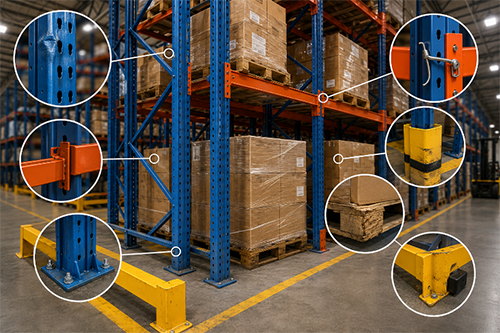
Upright frames are the vertical load-bearing backbone of any pallet racking system. They are responsible for transferring total pallet loads from beam levels down to the floor anchoring system. Any deformation, even at a small scale, directly affects load distribution across the entire racking bay.
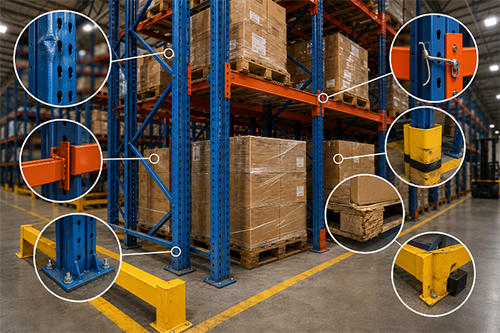
In real warehouse environments, upright damage is most commonly caused by repeated forklift impact at low height levels. These impacts often appear minor visually, but they introduce permanent plastic deformation in the steel structure, weakening its load-carrying geometry.
Upright deformation → vertical load eccentricity → beam overload increase → progressive structural instability
Key inspection indicators include:
- Forklift impact dents at lower column sections
- Visible bending or twisting deformation
- Loss of vertical alignment across rack rows
- Surface coating damage exposing corrosion risk
- Repeated impact marks indicating fatigue accumulation
Once an upright column is permanently deformed, its ability to distribute compressive loads evenly is reduced. This creates localized stress concentration points that accelerate structural fatigue in connected beams and joints.
Any visible upright deformation = immediate load reduction + engineering inspection required
6. Beam Structural Integrity Inspection – Horizontal Load Transfer System
Beams are responsible for transferring pallet loads horizontally from storage positions to upright frames. They operate under repeated bending stress cycles, making them highly sensitive to overloading and uneven pallet distribution.
Unlike upright frames, beam failures typically develop through progressive deflection rather than sudden fracture. This makes early detection critical for preventing long-term structural collapse.
Overload or uneven pallet weight → elastic deflection → plastic deformation → permanent sagging → load capacity reduction
Inspection should focus on:
- Visible beam sagging under load or after unloading
- Connector hook deformation or cracking
- Locking pin presence and stability
- Weld joint fatigue or micro-cracks
- Uneven load distribution across beam span
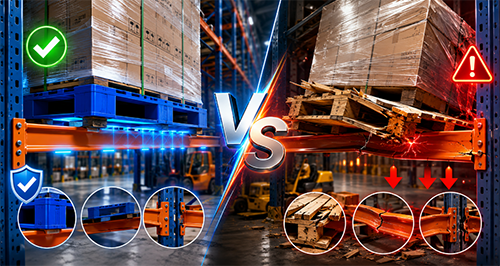
Permanent beam deflection is a critical warning sign indicating that the load has exceeded design limits. Once plastic deformation occurs, the original rated capacity can no longer be guaranteed.
Any beam deflection beyond elastic range = immediate load reduction + structural evaluation required
7. Base Plate & Anchor Bolt System – Ground Stability Mechanism
The base plate and anchor bolt system is responsible for transferring all vertical and lateral loads from the racking structure into the warehouse floor slab. It plays a critical role in preventing lateral movement and structural tipping during forklift operations.
Anchor bolt failure is particularly dangerous because it often develops silently. Loosening can occur gradually due to vibration, repeated loading cycles, or improper installation torque.
Loose anchor bolts → base instability → upright misalignment → load redistribution → system collapse risk
Inspection should include:
- Anchor bolt presence and tightness verification
- Base plate deformation or bending signs
- Concrete floor cracking around anchor points
- Signs of lateral movement or shifting
Even if uprights and beams appear structurally sound, failure at the anchor level compromises the entire system stability.
Racking stability is not determined by visible steel condition alone, but by the integrity of the floor anchoring system.
8. Forklift Impact Dynamics – Structural Damage Propagation Model
Forklift impact is the most common initiating event in warehouse racking damage. However, the actual risk is not the visible dent or collision mark, but the internal stress wave that propagates through the steel structure immediately after impact.
When a forklift collides with an upright frame, energy is transferred into the steel column as localized plastic deformation. This creates internal stress redistribution across adjacent structural members, even if no immediate visible failure occurs.
Forklift collision → Local plastic deformation → Stress wave propagation → Load path redistribution → Progressive fatigue accumulation
Repeated low-energy impacts are more dangerous than single high-energy impacts, because they create cumulative micro-deformation cycles that weaken structural integrity over time without triggering immediate failure warnings.
9. Safety Accessories System – Energy Absorption and Protection Layer
Safety accessories are not optional components in modern warehouse racking systems. They function as energy absorption and impact redistribution layers designed to protect primary structural members from direct forklift collision damage.
These components typically include upright protectors, column guards, end-of-aisle barriers, and row spacers. Their engineering purpose is to absorb and dissipate kinetic energy before it reaches the load-bearing steel structure.
Forklift impact → safety accessory deformation → energy dissipation → reduced upright stress exposure
Without safety accessories, even low-speed forklift contact directly transfers impact forces into upright frames, significantly increasing the probability of structural deformation.
- Upright column guards – absorb lateral impact energy
- End-of-aisle barriers – protect high-traffic collision zones
- Row spacers – maintain structural alignment stability
- Beam safety pins – prevent accidental disengagement
10. Pallet Condition & Load Transfer Stability
Pallet condition is a frequently underestimated factor in warehouse racking safety. The structural integrity of the pallet directly influences how load is transferred onto beam levels.
Damaged or uneven pallets create localized stress concentration points, which result in uneven beam loading. This significantly increases the risk of beam deflection and long-term structural fatigue.
Damaged pallet → uneven weight distribution → localized beam stress → accelerated deformation
Common pallet-related risk factors include cracked stringers, broken deck boards, and warped plastic bases. These defects reduce load stability and increase the likelihood of point-load concentration.
11. Wire Decking Load Distribution System
Wire decking plays a secondary structural role in pallet racking systems by improving load distribution and preventing pallet fall-through incidents. It acts as a supplementary support layer between beams.
From an engineering perspective, wire decking helps distribute concentrated pallet loads across a wider beam surface area, reducing stress intensity at single contact points.
Point load → distributed load → reduced beam stress concentration → improved structural stability
Damaged or improperly installed wire decking can create the opposite effect by introducing instability points and uneven load distribution across beam levels.
12. Full Industrial Inspection Checklist
A true industrial-grade warehouse racking inspection is not a simple checklist. It is a structured engineering evaluation system designed to assess multiple failure domains simultaneously.
- Upright deformation and vertical alignment deviation
- Beam deflection and connector integrity
- Anchor bolt stability and base plate condition
- Forklift impact damage zones
- Load distribution and pallet integrity
- Wire decking installation and deformation
- Safety accessories condition and presence
- Aisle clearance and forklift operation safety zones
Each inspection category must be evaluated not only visually, but also through engineering judgment regarding load behavior, stress propagation, and fatigue accumulation risk.
13. Warehouse Racking Risk Classification System
Risk classification in warehouse racking systems is not a visual grading exercise. It is an engineering decision model used to determine whether a structure can continue operating safely under dynamic load conditions.
???? GREEN RISK – Operational Safe Condition
Green-level conditions indicate that the racking system remains structurally sound with no significant deformation or load-bearing compromise.
- Minor surface scratches or paint damage
- Non-structural corrosion spots
- No measurable deformation in uprights or beams
- Stable anchor and base condition
Action: Continue normal operation with routine monitoring during scheduled inspections.
???? AMBER RISK – Controlled Operation Required
Amber-level conditions indicate early structural warning signs where the system remains operational but requires controlled usage and corrective action planning.
- Minor upright deformation or bending
- Beam deflection beyond normal elastic range
- Loose anchor bolts or minor base instability
- Repeated forklift impact marks in localized zones
Amber condition = load reduction (10–30%) + increased inspection frequency
???? RED RISK – Immediate Structural Hazard
Red-level conditions represent critical structural failure risk where continued operation may result in collapse or severe safety incidents.
- Severely bent or twisted uprights
- Missing or broken anchor bolts
- Major beam deformation or cracking
- Visible structural instability or misalignment
Red condition = immediate unload + isolate rack zone + engineering inspection required before reuse
14. Repair vs Replacement Engineering Decision Logic
One of the most critical decisions in warehouse racking maintenance is determining whether a damaged component can be repaired or must be replaced.
This decision is based on structural deformation severity, not visual appearance.
Elastic deformation → repair possible
Plastic deformation → replacement required
Structural cracking → immediate replacement required
Upright frames and beams that have experienced plastic deformation cannot reliably restore original load-bearing capacity even after mechanical straightening.
15. Real Warehouse Failure Scenarios
Most warehouse racking failures follow predictable progression patterns rather than random collapse events.
Scenario 1: Repeated Forklift Impact Failure
Minor forklift collisions at upright base level gradually create micro-deformation zones. Over time, load redistribution increases beam stress, eventually leading to localized instability and system failure.
Scenario 2: Overloading-Induced Beam Collapse
Continuous operation beyond rated load capacity leads to elastic beam deflection. Once plastic deformation occurs, load capacity decreases permanently, accelerating collapse risk under normal usage.
Scenario 3: Anchor Bolt Failure Chain Reaction
Loose anchor bolts cause base instability. This leads to upright misalignment, uneven load distribution, and eventual system-wide structural failure under forklift dynamic loading.
16. Frequently Asked Questions
What is the most dangerous type of rack damage?
Severe upright deformation and anchor bolt failure are the most dangerous conditions because they directly compromise structural load paths.
Can damaged pallet racking be repaired?
Minor damage can be repaired, but any plastic deformation in structural members typically requires replacement to ensure safety compliance.
How often should warehouse racking be inspected?
Daily visual checks, weekly supervisory inspections, monthly maintenance audits, and annual certified engineering inspections are recommended.
17. Conclusion – Warehouse Racking as a Continuous Safety System
Warehouse racking safety cannot be maintained through occasional inspections alone. It requires a continuous engineering monitoring system that identifies early-stage deformation, structural fatigue, and operational misuse before failure occurs.
Most rack failures are preventable. They occur due to overlooked damage accumulation rather than sudden structural collapse.
Warehouse racking inspection is not a checklist task — it is a structural risk management system that protects people, inventory, and operational continuity.
18. Recommended Safety Solutions
- Rack Upright Protectors – reduce forklift impact energy transfer
- Wire Mesh Decking – improve load distribution stability
- Upright Guards – protect high-frequency collision zones
- Heavy-duty Pallet Racking Systems – higher structural load capacity
Each solution is designed to address a specific failure mechanism within warehouse racking systems, improving structural resilience and reducing long-term maintenance risk.
-
-
PRODUCTS
-
NEWS
-
FOLLOW US
-


 link:
Spieth Medical
link:
Spieth Medical


 if you have questions or suggestions,please leave us a message,we will reply you as soon as we can



-

-
 +86 18006010205
 -
 +86 18006010205
 0
0