 [email protected]
 +86 18006010205



-
Spieth, Space solutionsMore Than 18 Years Manufacturing & Exporting
-
 Time:7/6/2026
 -
 Time:6/24/2026
 -
 Time:6/23/2026
-
 Tel : +86 18006010205
-
 E-mail : [email protected]
-
 Address : Tongan Park, Tongan District, Xiamen, China 361023
Cantilever Rack vs Honeycomb Rack: Key Differences
 Time:7/6/2026
 6
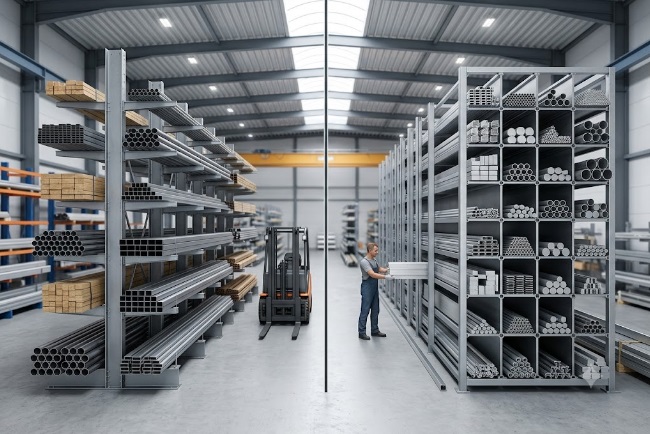
6In industrial warehouse environments, long material storage is rarely a matter of preference. It is a constraint-driven engineering decision shaped by material type, handling frequency, space availability, and safety requirements. Steel bars, aluminum profiles, structural tubes, and similar elongated products behave very differently from palletized goods, and therefore require dedicated storage systems designed specifically for their physical characteristics.
Among the most commonly used solutions in this category are cantilever rack systems and honeycomb rack systems. While both are designed to handle long materials, their engineering logic, structural behavior, and operational workflow differ significantly.
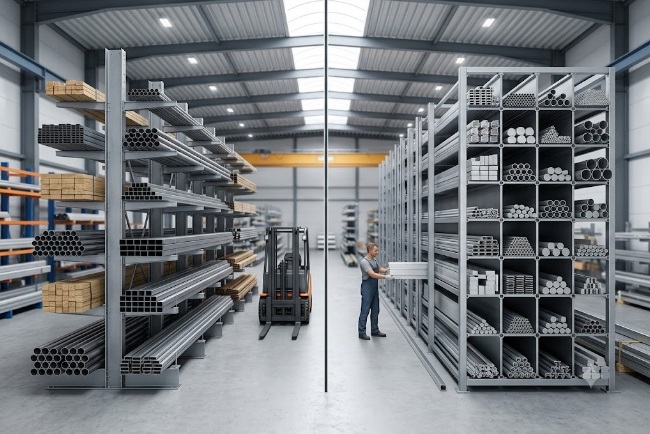
1. The Traditional Choice: Cantilever Rack Systems
In most traditional steel service centers and fabrication warehouses, cantilever racks remain the default choice due to their simplicity and proven structural reliability. However, as warehouse operations become more complex—particularly with increasing SKU variety and higher retrieval frequency—limitations in cantilever-based systems become more visible. These limitations appear directly in daily operations, especially in material access efficiency, space utilization, and load stability under uneven distribution.
Structural Principle & Load Behavior
Cantilever rack systems are based on a relatively straightforward structural principle. Horizontal arms extend from vertical columns, forming an open-front storage structure. Load is transferred through bending moments at the arm-to-column connection point, and stability depends heavily on the rigidity of the vertical support frame and base anchoring system.
In real warehouse conditions, this structure performs well when load distribution is consistent and predictable. However, long materials are rarely uniform in practice. Steel pipes and bars often vary in length, weight, and stacking configuration. When these materials are unevenly distributed across cantilever arms, the system is subjected to asymmetric loading conditions. This creates torsional stress along the arm span, which can accumulate over time and lead to gradual structural deformation.
Operational Implications
Operationally, cantilever systems depend heavily on access clearance in front of the rack structure. Forklift operators require sufficient maneuvering space to load and retrieve materials. In high-density warehouse layouts, this requirement reduces achievable storage density per square meter. Additionally, when materials are stored in multiple layers, accessing inner stock may require repositioning outer bundles, increasing handling steps and reducing overall picking efficiency.
Despite these limitations, cantilever systems remain widely used because of their low structural complexity, ease of installation, and compatibility with standard industrial warehouse layouts. In environments where storage cost efficiency is prioritized over retrieval speed, cantilever racks continue to offer a practical and economically viable solution.
2. The High-Density Alternative: Honeycomb Rack Systems
In contrast, honeycomb rack systems introduce a fundamentally different approach to long material storage. Instead of relying on shared horizontal arms, honeycomb structures are built around a modular grid of independent storage slots. Each slot functions as a separate storage unit, designed to hold individual material bundles without mechanical dependency on adjacent units.
Engineering Logic & Access Independence
From an engineering perspective, this design changes the entire load distribution model. Rather than transferring weight through horizontal cantilever arms, honeycomb systems distribute load vertically through reinforced frame columns and isolated slot structures. This reduces the propagation of stress between adjacent storage positions and improves stability under uneven loading conditions.
The most significant operational advantage of this system lies in access independence. Each storage slot can be accessed individually without disturbing surrounding materials. In practice, this reduces secondary handling operations, particularly in warehouses with frequent picking cycles or mixed-material inventory.
Mechanical Complexity & Limits
However, honeycomb systems also introduce additional engineering complexity. The inclusion of sliding or pull-out mechanisms requires precise alignment and regular maintenance to ensure smooth operation. Over time, mechanical wear in guide rails and support tracks can affect system efficiency if not properly maintained. Additionally, each storage slot has a defined load capacity, and exceeding this limit can lead to localized deformation or mechanical resistance during retrieval operations.
3. Engineering & Operational Comparison
When comparing both systems from an engineering standpoint, the fundamental difference lies in load behavior and operational workflow structure. Cantilever systems rely on horizontal load transfer and shared structural support, making them suitable for bulk storage environments with low retrieval frequency. Honeycomb systems rely on isolated load units and vertical load transfer, making them more suitable for high-frequency access environments where operational efficiency is prioritized.
| Performance Metric | Cantilever Rack System | Honeycomb Rack System |
|---|---|---|
| Load Transfer Model | Horizontal load transfer via bending moments at arm-to-column connections. | Vertical load transfer via isolated, reinforced frame structures. |
| Selectivity & Access | Shared layer storage. May require reshuffling outer bundles to reach inner stock. | 100% independent slot access. Zero interference with adjacent stock. |
| Space Optimization | Lower density due to wide front aisle clearance required for forklift maneuvering. | Highly compact, modular layout maximizing vertical and cubic floor space. |
| Risk & Sensitivity | Sensitive to asymmetric loading and torsional stress from uneven weights. | Strict per-slot weight thresholds; sensitive to mechanical wear of guide rails. |
| Maintenance Profile | Low maintenance. Simple rigid structure with no moving parts. | Moderate to High. Requires regular track alignment and rail lubrication. |
4. Strategic Selection: Making the Right Engineering Decision
From a selection perspective, the decision between these two systems should not be based on structural superiority, but on operational requirements. Cantilever systems are generally more suitable for environments handling bulk long materials with low turnover rates, where simplicity and cost efficiency are key priorities. Honeycomb systems are more appropriate for operations requiring frequent access, multiple material categories, and higher workflow efficiency.
In many modern industrial warehouse designs, hybrid configurations are increasingly common. Cantilever racks are used in bulk storage zones, while honeycomb systems are deployed in high-frequency picking areas. This hybrid approach reflects a more realistic understanding of warehouse operations, where no single system can optimize all performance variables simultaneously.
Ultimately, the selection of a long material storage system should be based on workflow analysis rather than equipment availability. Factors such as material type distribution, retrieval frequency, available space, and handling equipment all play a role in determining the most suitable solution. In this context, both cantilever and honeycomb rack systems serve important but fundamentally different roles within industrial storage infrastructure.
Optimize Your Long Material Storage Layout Today
Choosing between cantilever and honeycomb systems requires a deep understanding of your operational throughput and floor constraints. Let our engineering team design a complimentary, space-optimized warehouse layout for your facility.
Request a Free Engineering Consultation-
-
PRODUCTS
-
NEWS
-
FOLLOW US
-


 link:
Spieth Medical
link:
Spieth Medical


 if you have questions or suggestions,please leave us a message,we will reply you as soon as we can



-

-
 +86 18006010205
 -
 +86 18006010205
 0
0