 [email protected]
 +86 18006010205



-
Spieth, Space solutionsMore Than 18 Years Manufacturing & Exporting
-
 Time:6/24/2026
 -
 Time:6/23/2026
 -
 Time:6/17/2026
-
 Tel : +86 18006010205
-
 E-mail : [email protected]
-
 Address : Tongan Park, Tongan District, Xiamen, China 361023
What is Australian Standard AS 4084 for Steel Storage Racking
 Time:6/29/2026
 9
9AS 4084 is the Australian engineering standard that defines how steel pallet racking systems must be designed, installed, and maintained to ensure warehouse safety, structural stability, and compliance with workplace regulations.
What is AS 4084?
AS 4084 (Steel Storage Racking Standard) is a nationally recognized Australian standard developed by Standards Australia. It defines the minimum structural and safety requirements for industrial pallet racking systems used in warehouses and logistics facilities.
The standard ensures that racking systems can safely withstand real-world warehouse conditions including forklift impact, uneven loading, and long-term structural stress.
Why AS 4084 Matters in Warehouse Operations
In Australia, warehouse racking systems must comply with AS 4084 to ensure safety, meet insurance requirements, and avoid structural failure risks. It is not only a technical guideline but also a legal benchmark for industrial storage systems.
Safety Compliance
Reduces risk of warehouse collapse, forklift accidents, and structural failures.
Insurance Requirement
Non-compliance may lead to insurance claim rejection or liability issues.
Engineering Control
Ensures racking systems are designed with verified structural calculations.
Structural Design Requirements Under AS 4084
AS 4084 defines strict engineering requirements for pallet racking systems, ensuring that every component is designed to withstand static loads, dynamic forklift impact, and long-term structural stress in real warehouse environments.
1. Load Design & Capacity Calculation
One of the core requirements of AS 4084 is that all racking systems must be designed based on verified load calculations. This includes pallet weight, beam distribution, and overall frame stability under operational conditions.
Static Load
Permanent pallet weight stored on beams without movement.
Dynamic Load
Additional force caused by forklift handling and pallet placement.
Safety Factor
Extra structural margin to prevent failure under unexpected overload.
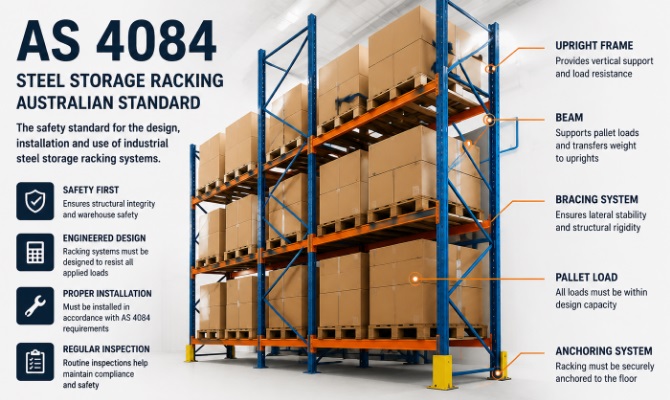
Uprights, Beams & Bracing System
AS 4084 requires pallet racking systems to be composed of engineered structural components that work together to ensure stability and load distribution.
- Upright Frames: Vertical load-bearing structure resisting compression and bending.
- Beams: Horizontal load support distributing pallet weight evenly.
- Bracing: Diagonal and horizontal reinforcement preventing lateral collapse.
- Baseplates: Anchor system connecting rack to concrete floor.
Forklift Impact & Real Warehouse Conditions
Unlike theoretical design models, AS 4084 considers real warehouse environments where forklifts frequently interact with racking systems. This includes accidental impacts, pallet misalignment, and repetitive loading cycles.
Side Impact Loads
Forklift collisions with upright frames during turning or pallet placement.
Load Misalignment
Improper pallet placement causing uneven beam stress distribution.
Repeated Stress Cycles
Long-term fatigue from continuous loading and unloading operations.
AS 4084 Installation Standards for Warehouse Racking Systems
Even when a racking system is structurally designed correctly, improper installation can lead to instability, load imbalance, and safety risks. AS 4084 defines strict installation tolerances and anchoring requirements to ensure real-world operational safety.
1. Installation Tolerances & Alignment Control
AS 4084 requires that all racking structures must be installed within strict vertical and horizontal tolerances. Even minor misalignment can significantly reduce load capacity and structural stability.
Vertical Plumbness
Upright frames must remain within defined vertical deviation limits to prevent load shift.
Beam Level Accuracy
Beam levels must be horizontally aligned to ensure uniform pallet load distribution.
Frame Squareness
Structural frames must maintain geometric integrity to avoid torsional stress.
Baseplate & Concrete Anchoring Requirements
AS 4084 requires all pallet racking systems to be securely anchored to a concrete slab using certified mechanical or chemical anchors. This ensures structural stability under both static and dynamic loads.
- Anchor Bolts: Must be load-rated and certified for industrial use.
- Baseplates: Distribute load pressure evenly to the floor.
- Concrete Slab: Must meet minimum compressive strength requirements.
- Fixing Depth: Anchors must achieve structural grip within slab depth.
2. Inspection & Maintenance System
AS 4084 emphasizes that racking safety is not a one-time installation requirement. Continuous inspection and maintenance are required to ensure long-term structural integrity.
Routine Visual Checks
Weekly internal inspections to identify visible damage or misalignment.
Annual Engineering Audit
Certified structural inspection to verify compliance and load safety.
Damage Classification
Identification of minor, moderate, and critical structural damage levels.
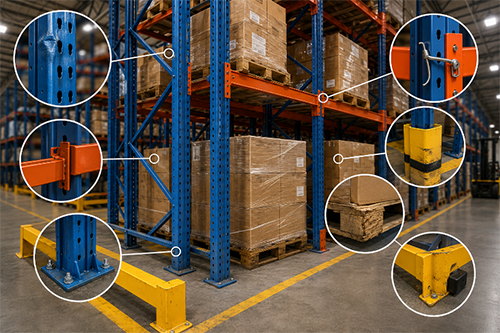
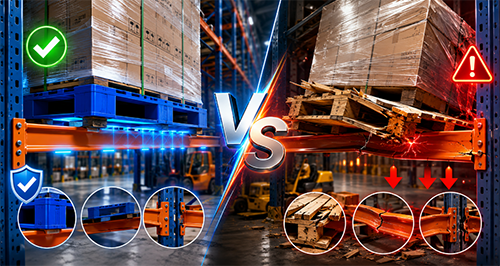
Common Structural Damage Indicators
Bent Uprights
Indicates forklift impact or excessive lateral load stress.
Beam Deflection
Suggests overload conditions or uneven pallet distribution.
Loose Anchors
Reduces structural stability and increases collapse risk.
AS 4084 Compliance Checklist for Warehouse Racking Systems
Before operating a warehouse racking system in Australia, ensure all structural, installation, and safety requirements are fully aligned with AS 4084 standards.
✔ Engineering Design
Load calculations verified by structural engineering principles and safety factors.
✔ Certified Materials
Steel grade, thickness, and manufacturing process comply with industrial standards.
✔ Professional Installation
System installed within AS 4084 tolerance limits and anchored correctly.
✔ Regular Inspection
Routine and annual inspections performed by qualified personnel.
Why AS 4084 Compliance Matters for Insurance & Safety
In Australia, warehouse racking systems are directly linked to workplace safety regulations and insurance liability. Non-compliance with AS 4084 may result in serious operational and financial consequences.
Insurance Risk
Claims may be rejected if racking systems are not AS 4084 compliant.
Legal Liability
Employers may be held responsible for workplace accidents caused by structural failure.
Operational Downtime
Structural issues can force warehouse shutdowns and disrupt logistics flow.
AS 4084 vs Global Racking Standards
Understanding how AS 4084 compares with other global standards helps international buyers and warehouse operators make informed engineering decisions.
AS 4084 (Australia)
Strong focus on installation tolerances, inspection cycles, and forklift impact resistance in real warehouse conditions.
EN 15512 (Europe)
Emphasizes structural engineering calculations and Eurocode-based design methodology.
RMI MH16.1 (USA)
Focuses on standardized racking design practices and seismic considerations in North America.
Need AS 4084 Compliant Warehouse Racking Solutions?
We design and manufacture industrial pallet racking systems that meet international safety standards including AS 4084. Contact our engineering team for customized warehouse solutions.
This article is intended for engineering and informational purposes only. Final design and compliance verification should be conducted by qualified structural engineers according to AS 4084 requirements.
-
-
PRODUCTS
-
NEWS
-
FOLLOW US
-


 link:
Spieth Medical
link:
Spieth Medical


 if you have questions or suggestions,please leave us a message,we will reply you as soon as we can



-

-
 +86 18006010205
 -
 +86 18006010205
 0
0