 [email protected]
 +86 18006010205



-
Spieth, Space solutionsMore Than 18 Years Manufacturing & Exporting
-
 Time:6/24/2026
 -
 Time:6/23/2026
-
 Tel : +86 18006010205
-
 E-mail : [email protected]
-
 Address : Tongan Park, Tongan District, Xiamen, China 361023
Why Cheap Warehouse Racking Systems Often Cost More in the Long Run
 Time:6/30/2026
 8
8
In industrial warehouse engineering, pallet racking systems are not simple storage products. They are structural steel systems designed to operate under dynamic loading, forklift impact, and long-term fatigue stress over 10–20 years.
From an engineering perspective, evaluating racking systems only by purchase price ignores the most important factor: lifecycle performance under real warehouse conditions.
This white paper explains why low-cost warehouse racks often result in higher total cost of ownership (TCO), based on structural engineering principles, international standards, and real operational behavior.
1. Warehouse Racking Is a Structural Engineering System, Not a Commodity
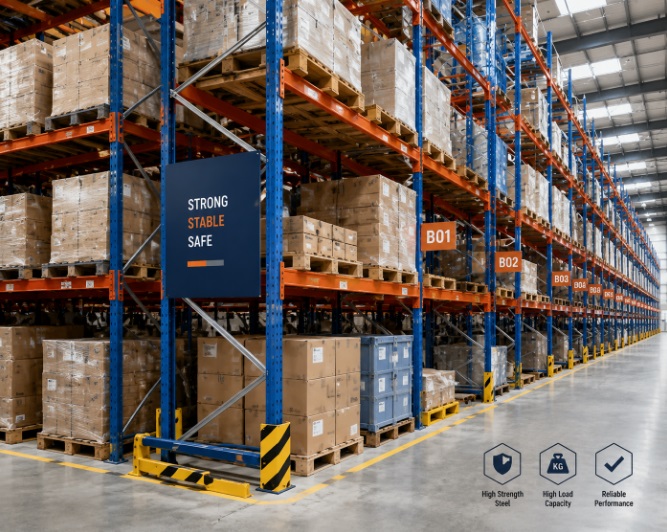
Pallet racking systems are governed by international structural design standards, which define safety, load behavior, and long-term performance requirements.
These standards define upright stability, beam deflection limits, joint stiffness behavior, impact resistance, and required safety factors under dynamic loading conditions.
In most low-cost warehouse racking systems, price reduction is not achieved through design innovation, but through material reduction and simplified structural components.
These changes directly affect structural safety margins defined in EN 15512 and FEM guidelines.
One of the most common cost-saving methods is reducing upright steel thickness.
This results in approximately 20–25% reduction in steel usage.
While both designs may still meet nominal load capacity, thinner uprights significantly reduce buckling resistance and long-term structural stability.
Low-cost systems often use simplified beam connectors with reduced contact area and lower-grade locking mechanisms.
These components reduce manufacturing cost but increase joint rotation under load.
The result is higher beam deflection and faster fatigue accumulation during repeated forklift operations.
Another common cost reduction strategy is lowering surface coating thickness or using lower-grade powder coating materials.
This leads to faster corrosion in humid or industrial environments, especially at welded joints and base plate areas.
Over time, corrosion reduces structural integrity and increases maintenance frequency.
A pallet racking system is not a static load structure. In real warehouse environments, it is continuously exposed to dynamic mechanical stress.
These conditions are significantly more complex than theoretical design load assumptions.
Low-cost racking systems often generate higher maintenance frequency due to reduced structural tolerance and lower impact resistance.
These issues are often caused by forklift impacts and cumulative loading stress beyond elastic deformation limits.
Replacing a beam typically takes 20–40 minutes.
However, replacing an upright column requires unloading 10–20 pallet positions and temporarily shutting down an aisle.
In many cases, labor cost exceeds the cost of the replacement component itself.
Structural repairs in warehouse racking systems are not isolated maintenance tasks. They directly affect warehouse flow and operational efficiency.
When a damaged upright is replaced, adjacent storage positions often need to be unloaded to ensure safe structural access.
This creates cascading operational delays across picking, storage, and outbound logistics processes.
The purchase price of a racking system is easy to compare. However, the cost of downtime is significantly harder to quantify and is often underestimated in procurement decisions.
In industrial warehouse operations, downtime frequently represents the largest hidden cost over the system lifecycle.
Consider a warehouse with 5,000 pallet positions operating in continuous distribution cycles.
Forklift operators must reroute movement paths, inventory may need temporary relocation, and picking sequences become inefficient.
Downtime does not scale linearly with time. A short disruption during peak shipping hours can have disproportionate effects on order fulfillment and delivery performance.
This is because warehouse operations are tightly synchronized systems, where storage, picking, and dispatch are interdependent.
A disruption in one aisle can propagate across the entire fulfillment chain.
Experienced warehouse engineers rarely evaluate pallet racking systems based on purchase price alone.
Instead, they use Total Cost of Ownership (TCO) to evaluate the full lifecycle cost of the system.
Initial Cost: $30,000
Service Life: 10 years
Annual Maintenance: $800
Initial Cost: $33,000
Service Life: 18 years
Annual Maintenance: $500
Warehouse operations typically expand within 3–5 years as business volume increases.
Low-cost systems often lack standardized components, making expansion difficult or incompatible with existing structures.
This results in partial or full system redesign, increasing long-term capital expenditure.
-
-
PRODUCTS
-
NEWS
-
FOLLOW US
-


 link:
Spieth Medical
link:
Spieth Medical


 if you have questions or suggestions,please leave us a message,we will reply you as soon as we can



-

-
 +86 18006010205
 -
 +86 18006010205
 0
0