+86 18006010205






 Time:2/6/2026
 225
225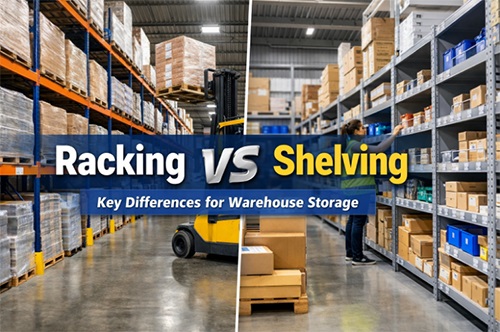
Understanding the real differences between racking and shelving helps warehouse managers reduce handling risks, improve space utilization, and avoid costly layout changes later.
This article explains the key differences between racking and shelving from a practical warehouse operation perspective.
What Is Warehouse Racking?
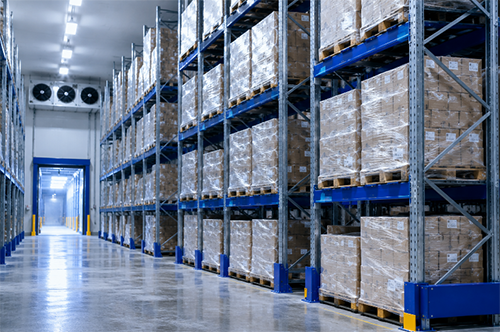
Warehouse racking is a heavy-duty storage system designed primarily for palletized goods. Loads are stored on pallets and handled by forklifts, reach trucks, or automated equipment.
A standard racking system consists of upright frames, horizontal beams, safety locks, and optional accessories such as pallet supports, wire decking, and rack protection.
Common warehouse racking types include:
- Selective pallet racking
- Drive-in and drive-through racking
- Shuttle racking and other semi-automated systems
Racking is mainly used in facilities where high-volume pallet storage and mechanical handling are required.
From a practical engineering viewpoint, racking systems focus on load capacity, vertical utilization, and structural stability under dynamic forklift operations.
What Is Warehouse Shelving?
Warehouse shelving is designed for manual or light mechanical handling of goods. Products are typically placed directly onto shelves and picked by operators.
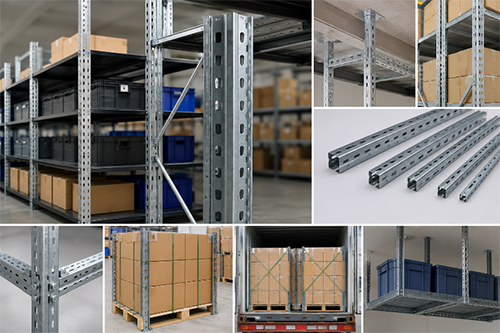
A shelving system usually includes vertical posts, shelf panels or decks, beams, and optional dividers or bins.
Common shelving types used in warehouses include:
- Longspan shelving
- Light-duty shelving
- Medium-duty shelving
Shelving is widely used in picking areas, spare parts storage, e-commerce fulfillment zones, and maintenance rooms.
Unlike racking, shelving systems prioritize accessibility, ergonomic picking, and flexible reconfiguration rather than forklift handling and pallet loads.
Racking vs Shelving – Key Differences for Warehouse Storage
Load capacity
Racking is engineered to carry heavy pallet loads, often ranging from hundreds to several thousand kilograms per level. Shelving is designed for lighter items, cartons, and individual products.
Storage unit
Racking stores palletized loads. Shelving stores loose items, cartons, totes, or small components.
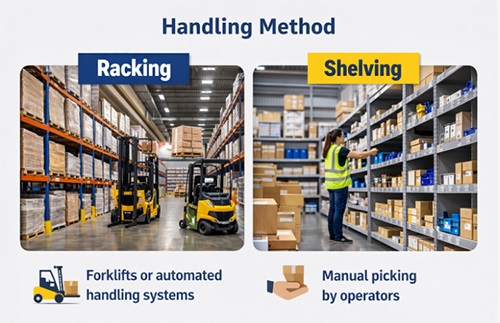
Handling method
Racking relies on forklifts or automated handling systems. Shelving is mainly used for manual picking and replenishment.
Aisle and layout requirements
Racking layouts must allow sufficient aisle width for material handling equipment. Shelving layouts can be more compact because operators move on foot.
Installation and structural requirements
Racking systems are structural installations. They require floor flatness verification, anchoring, and professional installation to meet safety and load standards. Shelving systems are typically simpler to install and relocate.
Scalability and layout flexibility
Shelving is easier to modify and reconfigure as SKUs change. Racking systems are more rigid and usually require engineering review when layouts are changed.
Typical applications
Racking is mainly used in bulk storage and reserve storage zones. Shelving is used in order picking, sorting, kitting, and light storage areas.
Racking vs Shelving – Comparison Table
| Item | Racking | Shelving |
|---|---|---|
| Typical load | Heavy pallet loads | Light to medium manual loads |
| Handling method | Forklifts / automated equipment | Manual picking |
| Storage unit | Pallets | Cartons, totes, loose items |
| Aisle width | Wider for equipment | Narrower for foot traffic |
| Installation | Anchored and engineered | Simple, modular installation |
| Typical use | Bulk and reserve storage | Picking and small parts storage |
| Layout flexibility | Medium | High |
When Should You Choose Racking?
Racking is the correct choice when your operation requires:
- High-volume pallet storage
- Forklift-based handling processes
- Medium to high bay warehouse buildings
- Strong vertical storage utilization
- Structured and stable long-term layouts
Typical facilities that rely heavily on racking include distribution centers, manufacturing warehouses, and regional logistics hubs.
From real project experience, racking delivers the highest return on investment when pallet turnover is high and floor space is limited.
When Should You Choose Shelving?
Shelving is more suitable when your operation focuses on:
- Manual picking and order fulfillment
- Storage of cartons, spare parts, and small items
- Frequent SKU changes
- High picking frequency with short travel distances
Shelving is commonly used in e-commerce fulfillment centers, maintenance warehouses, spare parts rooms, and back-of-house storage areas.
In practice, shelving improves picking efficiency and reduces operator fatigue when items are handled individually.
Can Racking and Shelving Be Used Together in One Warehouse?
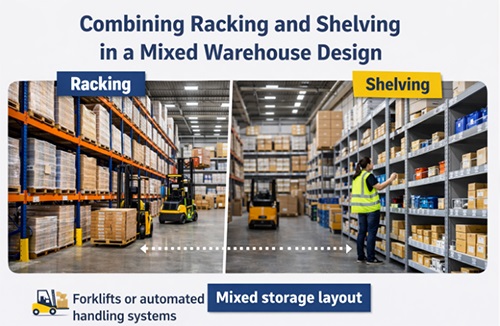
Yes. In modern warehouse design, combining racking and shelving is often the most efficient solution.
A common layout approach is:
- Use racking in reserve storage and bulk pallet zones
- Use shelving in forward picking areas
Pallets are stored in racking and replenished into shelving locations for picking. This hybrid layout reduces congestion in forklift aisles and improves order processing speed.
For many medium and large warehouses, a mixed racking and shelving layout delivers better overall throughput than using only one system.
Key Factors to Consider Before Making a Final Decision
- Product dimensions and weight distribution
- Palletization level of your inventory
- Daily picking volume and order profiles
- Available warehouse height and clearances
- Floor load capacity and flatness
- Existing handling equipment
- Expected business growth and future expansion plans
From an engineering and operations perspective, storage system selection should always start from real operational data rather than theoretical load values.
Final Thoughts – Choosing the Right Storage System for Your Warehouse
Racking and shelving are not competing solutions. They serve different roles within a professional warehouse environment.
Racking is optimized for pallet storage, vertical space utilization, and mechanical handling. Shelving is optimized for manual picking, flexibility, and fast access to individual items.
The most effective warehouse layouts are designed around actual workflows, not only storage density.
Working with an experienced storage system manufacturer and project team allows your warehouse to apply the correct combination of racking and shelving, ensuring safety compliance, operational efficiency, and long-term scalability.


 link:
link: