 [email protected]
 +86 18006010205



-
Spieth, Space solutionsMore Than 18 Years Manufacturing & Exporting
-
 Time:7/13/2026
 -
 Time:7/10/2026
 -
 Time:7/6/2026
-
 Tel : +86 18006010205
-
 E-mail : [email protected]
-
 Address : Tongan Park, Tongan District, Xiamen, China 361023
Warehouse Slotting for High-Density Pallet Racking
 Time:1/30/2026
 213
213
Warehouse slotting for high-density pallet racking is the structured process of assigning pallets and SKUs to specific storage lanes and levels in order to achieve the best balance between storage density, handling efficiency, and operational safety.
Unlike selective pallet racking, where every pallet position is directly accessible, high-density systems rely on deep lanes and restricted access logic. As a result, slotting decisions play a critical role in overall warehouse performance.
For operations using deep-lane and semi-automated racking solutions, an effective slotting strategy directly influences throughput, forklift travel distance, pallet handling accuracy, and long-term system reliability.

What Is Warehouse Slotting in Pallet Storage Environments
In pallet-based warehouses, warehouse slotting refers to the practical allocation of SKUs and pallet loads to defined rack locations based on operational characteristics such as product similarity, movement frequency, pallet dimensions, and handling constraints.
Slotting in pallet environments is fundamentally different from carton or piece-picking operations. The primary objective is not pick path optimization, but the efficient organization of pallet lanes, storage depth, and vertical levels while maintaining safe and predictable forklift access.
In high-density pallet racking systems, slotting becomes an operational design discipline rather than a simple location assignment task, because access to every pallet position is limited by the physical structure of the rack.
Key Constraints of High-Density Pallet Racking Systems
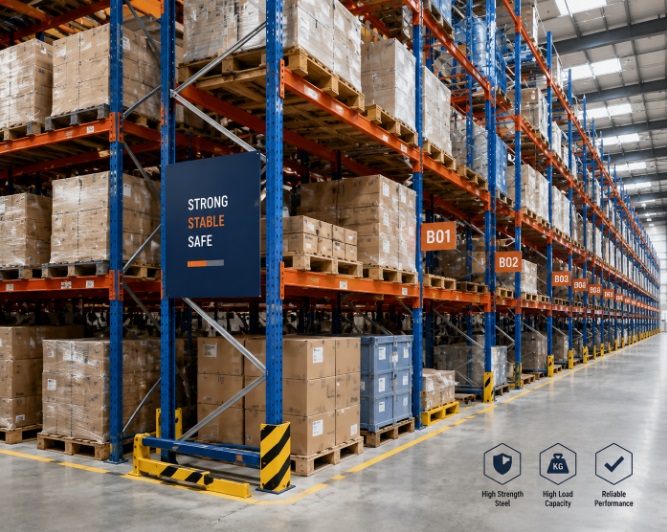
High-density pallet racking systems are designed to maximize storage capacity by reducing aisle space and increasing lane depth. This structural advantage introduces several operational constraints that must be considered during slotting.
First, direct access to individual pallet positions is limited. Forklifts must follow predefined entry paths into storage lanes.
Second, deep-lane structures require careful planning of lane depth and SKU allocation, as retrieval flexibility is restricted.
Third, operating logic varies by system type and is typically either FIFO (First-In, First-Out) or LIFO (Last-In, First-Out), which directly impacts inventory rotation and product suitability.
In addition, forklift entry clearance, travel paths, mast height, and turning radius impose physical limits on how pallets can be assigned to lanes and levels.
Compared with selective pallet racking, high-density systems require stricter slotting discipline due to their limited access and deeper storage configuration.
Core Slotting Factors for High-Density Pallet Storage
SKU Similarity and SKU Grouping
High-density pallet racking relies heavily on SKU consolidation. In most projects, each storage lane is dedicated to a single SKU or a single batch of similar products.
This one-lane–one-SKU principle avoids unnecessary reshuffling, reduces handling errors, and improves operational predictability.
Batch control and production lot management should also be integrated into slotting decisions, especially for food, beverage, and manufacturing buffer storage.
Pallet Weight and Load Stability
Pallet weight distribution is a key safety and engineering consideration. Heavier pallets are typically assigned to lower storage levels to minimize structural stress and improve forklift handling stability.
From an engineering perspective, load characteristics must be aligned with the designed load capacity of rails, beams, and frames. Slotting plans that ignore load distribution can negatively affect rack service life and long-term operational safety.
Inventory Turnover and Movement Frequency
Fast-moving SKUs and slow-moving SKUs should be assigned to different zones and lane depths whenever possible.
In deep-lane environments, maximizing density often increases travel distance and retrieval time. Slotting strategies must therefore balance storage capacity with operational efficiency, especially in facilities with high daily pallet movements.
Pallet Dimensions and Load Uniformity
High-density racking systems perform best with standardized pallet sizes and uniform load profiles.
Non-standard pallet dimensions, overhanging loads, damaged pallets, and unstable unit loads increase the risk of misalignment on support rails or gravity rollers. Slotting should prioritize consistent pallet formats to maintain smooth pallet handling and reduce impact damage.
Slotting Strategy by High-Density Pallet Racking Type
Slotting for Drive-In Pallet Racking
Drive-in pallet racking operates under a LIFO storage principle. Forklifts enter the rack structure and place pallets directly onto support rails within deep storage lanes.
Slotting for drive-in systems must focus on strong SKU grouping, as each lane is typically dedicated to a single product. Lane depth should be defined based on real inventory volume and realistic forklift handling capability rather than theoretical maximum depth.
Products with stable demand patterns and limited SKU variation are most suitable for drive-in slotting. Mixed-SKU lanes should be avoided to prevent blocking and unnecessary pallet relocation.
Slotting for Radio Shuttle Racking
Radio shuttle racking introduces semi-automated pallet handling within deep storage lanes. Although access remains lane-based, the shuttle enables faster pallet movements and higher throughput.
Slotting for shuttle systems must consider lane depth configuration, shuttle availability, and buffer lane allocation for inbound and outbound flows. High-volume SKUs are typically assigned to deeper lanes to fully leverage the density advantages of the system.
In high-throughput operations, shuttle assignment and SKU concentration should be planned together to avoid operational bottlenecks and idle equipment time.
Slotting for Pallet Flow Racking
Pallet flow racking uses gravity rollers to support FIFO operation. Pallets are loaded on the inbound side and automatically move to the picking or dispatch face.
Slotting in pallet flow systems should be organized according to rotation frequency and order profiles. High-rotation SKUs are usually assigned to easily accessible lanes with balanced inbound and outbound flow.
The physical separation of loading and picking faces allows better traffic control, but lane assignment must account for replenishment capacity and realistic inbound volumes to prevent congestion.
Slotting for Double Deep Pallet Racking
Double deep pallet racking stores two pallets in depth and operates with a front and rear position.
Slotting strategies should prioritize fast-moving SKUs in the front positions to minimize reshuffle movements. In most cases, pairing the same SKU in both front and rear locations reduces handling complexity and improves retrieval efficiency.
Forklift reach capability and mast height must be considered when assigning upper and rear pallet positions. Slotting that ignores equipment limitations can quickly lead to productivity losses and safety risks.
Common Slotting Mistakes in High-Density Pallet Racking Projects
One of the most frequent mistakes is mixing multiple SKUs within the same deep lane. This practice significantly reduces retrieval efficiency and increases pallet relocation.
Another common issue is designing lane depth without analyzing real inventory profiles. Excessively deep lanes may look efficient on layout drawings but often lead to blocked stock and poor space utilization in daily operations.
Ignoring forklift reach limits, aisle operating clearances, and vertical handling capability can also result in unusable locations after installation.
Finally, focusing exclusively on maximum storage density without considering throughput requirements often creates long-term operational constraints that are difficult to correct later.
How Slotting Influences Racking System Design and Layout
Slotting decisions directly affect the number of lanes, lane depth, and the overall block layout of high-density racking systems.
A small change in SKU grouping strategy can significantly alter the required number of lanes and aisle positions. Similarly, slotting requirements influence aisle width, traffic flow patterns, and rack face orientation.
For this reason, slotting should be defined before final rack layout approval. Treating slotting as a post-design activity frequently leads to compromises in both storage capacity and operational efficiency.
Engineering and Operational Best Practices
Effective slotting for high-density pallet racking should be based on real operational data, including historical order profiles, inbound and outbound volumes, and SKU turnover rates.
From an engineering standpoint, slotting must be coordinated with racking system design parameters such as load capacity, structural configuration, impact protection, and floor anchoring conditions. Collaboration between experienced racking engineers and warehouse operations teams is essential to ensure that both safety requirements and operational objectives are achieved.
Professional projects typically validate slotting scenarios during the design phase to confirm lane quantities, depth distribution, and handling capacity.
In addition, system designs should comply with recognized international racking standards, such as FEM and EN guidelines, and be adapted to regional project requirements, including seismic and operational safety considerations.
This integrated approach strengthens design reliability, improves long-term performance, and supports safer daily warehouse operations.
When High-Density Slotting Is the Right Choice for Your Warehouse
High-density slotting is most suitable for warehouses with large pallet volumes, relatively stable SKU profiles, and predictable inbound and outbound flows.
Facilities handling homogeneous products, seasonal stock, production buffers, or regional distribution volumes typically benefit most from deep-lane and semi-automated racking systems.
Warehouses with extremely high SKU variety and frequent order fragmentation may achieve better overall performance with alternative racking configurations that provide higher direct accessibility.
Conclusion – Aligning Warehouse Slotting with High-Density Pallet Racking Systems
Warehouse slotting is not a software function or an isolated planning exercise. In high-density pallet racking environments, it is a core operational and engineering discipline that determines how effectively the racking system can be used.
By aligning slotting strategy with the physical characteristics and access logic of drive-in, radio shuttle, pallet flow, and double deep racking systems, warehouses can achieve sustainable storage density, improved handling efficiency, and safer daily operations.
Early-stage slotting analysis, combined with professional racking system design, provides a reliable foundation for long-term warehouse performance in high-density pallet storage projects.
-
-
PRODUCTS
-
NEWS
-
FOLLOW US
-


 link:
Spieth Medical
link:
Spieth Medical


 if you have questions or suggestions,please leave us a message,we will reply you as soon as we can



-

-
 +86 18006010205
 -
 +86 18006010205
 0
0