 [email protected]
 +86 18006010205



-
Spieth, Space solutionsMore Than 18 Years Manufacturing & Exporting
-
 Time:7/10/2026
 -
 Time:7/6/2026

-
 Tel : +86 18006010205
-
 E-mail : [email protected]
-
 Address : Tongan Park, Tongan District, Xiamen, China 361023
Seismic Warehouse Racking: Design Standards & Safety Guide
 Time:7/10/2026
 10
10Warehouses are designed to safely support heavy inventory every day, but earthquakes introduce forces that standard storage calculations cannot fully address. Unlike the constant vertical loads generated by pallets and products, seismic activity creates sudden horizontal and vertical movements that place significant stress on warehouse racking systems.
Even when a warehouse building remains structurally sound after an earthquake, poorly designed or improperly installed racking can suffer serious damage. Beams may become dislodged, upright frames can deform, and entire rack rows may collapse, leading to damaged inventory, operational downtime, and safety risks for employees.
For businesses operating in earthquake-prone regions, seismic design is no longer considered an optional engineering upgrade. It has become an essential part of warehouse planning, helping companies comply with local building regulations while protecting people, products, and business continuity.
This guide explains how seismic warehouse racking is engineered, why earthquake magnitude alone is not a reliable design criterion, which international standards are commonly used, and what buyers should evaluate before selecting a storage system.
Why Seismic Design Matters for Warehouse Racking
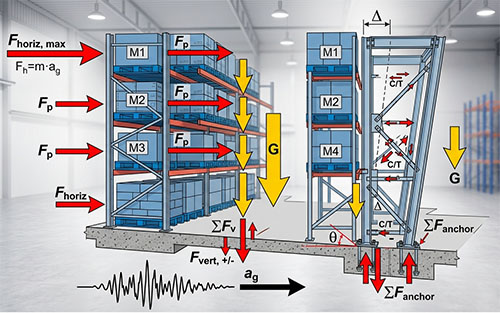
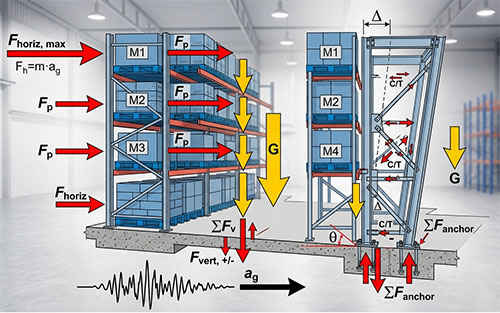
Warehouse racking is primarily designed to support static loads under normal operating conditions. During an earthquake, however, the structure is subjected to dynamic forces that act in multiple directions within seconds. These forces can be considerably more demanding than the weight of stored goods alone.
Unlike buildings, pallet racks are slender steel structures with relatively high centers of gravity. When fully loaded with pallets, they become more vulnerable to lateral movement and vibration. Without proper seismic engineering, even moderate ground motion can compromise the stability of the entire storage system.
The consequences of rack failure often extend well beyond damaged products. A collapsed storage system can block forklift routes, obstruct emergency exits, damage material handling equipment, and interrupt warehouse operations for days or even weeks. In industries such as logistics, food distribution, pharmaceuticals, and manufacturing, these disruptions may result in substantial financial losses.
According to the U.S. Federal Emergency Management Agency (FEMA), non-structural components—including storage systems, equipment, and utilities—represent a significant portion of earthquake-related economic losses in commercial and industrial buildings. While buildings are generally designed to protect lives, warehouse operators are also responsible for ensuring that storage equipment performs safely during seismic events.
For this reason, many countries now require warehouse storage systems to be evaluated according to seismic building codes rather than relying solely on conventional load capacity calculations.
Real-World Lessons from Earthquake Damage
Experience from earthquakes around the world has shown that warehouse rack failures are rarely caused by steel strength alone. In many cases, investigations reveal that the primary causes are improper engineering, incorrect installation, or inadequate maintenance.
Some of the most common problems include:
- Rack uprights that were not securely anchored to the concrete floor.
- Beam connectors without safety locking devices, allowing beams to disengage during vibration.
- Uneven pallet loading that creates excessive lateral forces.
- Damaged upright frames that were never repaired or replaced.
- Rack layouts that ignored seismic clearance requirements between rows.
- Storage systems installed without project-specific structural calculations.
In many post-earthquake inspections, engineers have found that the steel components themselves remained largely intact. Instead, failures often occurred because the entire rack system had not been designed as an integrated structural system capable of resisting seismic forces.
Another important lesson is that earthquakes expose weaknesses that may not be noticeable during everyday warehouse operations. A rack can perform perfectly for years under normal loading conditions yet fail unexpectedly when subjected to rapid horizontal acceleration. This is why relying solely on rated load capacity is insufficient when evaluating storage systems for seismic regions.
Proper seismic design considers not only the strength of individual components but also how the complete storage system behaves under dynamic loading. Factors such as floor anchorage, beam connections, frame bracing, rack geometry, pallet weight distribution, and warehouse layout all contribute to the overall seismic performance of the installation.
Rather than treating seismic resistance as a single product feature, experienced engineers view it as the result of careful structural analysis, compliant manufacturing, professional installation, and ongoing inspection throughout the service life of the warehouse.
Understanding the Goal of Seismic Design
One common misconception is that seismic warehouse racking is designed to eliminate all damage during a major earthquake. In reality, engineering standards pursue a more practical objective.
The primary goal of seismic design is to reduce the likelihood of catastrophic collapse, protect human life, and limit damage so that warehouse operations can recover more quickly after an earthquake. While some deformation or localized damage may still occur during severe seismic events, a properly engineered rack system is far more likely to remain stable and prevent progressive failure.
This approach is consistent with modern structural engineering principles used for buildings, bridges, and industrial facilities. Rather than attempting to create completely damage-proof structures, engineers focus on designing systems that can absorb seismic energy, maintain overall stability, and reduce the risk of life-threatening failures.
For warehouse operators, this translates into greater employee safety, reduced inventory losses, lower repair costs, and improved business continuity when unexpected seismic events occur.
Why Earthquake Magnitude Is Not the Design Standard
One of the most common questions buyers ask is:
"Can this warehouse rack withstand an 8.0 magnitude earthquake?"
Although this question seems reasonable, it is not how structural engineers evaluate seismic performance.
Earthquake magnitude measures the total energy released at the earthquake source. However, it does not indicate the actual force acting on a specific warehouse. Two facilities located at different distances from the same earthquake can experience completely different levels of ground motion. Likewise, local soil conditions, building height, structural design, and warehouse layout all influence how seismic forces are transmitted to the storage system.
For this reason, professional seismic rack design is based on ground acceleration rather than earthquake magnitude.
Ground acceleration describes how rapidly the ground moves during a seismic event and directly determines the horizontal forces acting on warehouse racking. This engineering approach allows designers to calculate realistic structural loads for a specific project instead of relying on generalized earthquake ratings.
When discussing seismic performance with a supplier, a far more meaningful question is:
"What peak ground acceleration (PGA) has this rack system been designed to resist?"
This provides a measurable engineering parameter that can be verified through structural calculations and applicable design standards.
What Is Peak Ground Acceleration (PGA)?
Peak Ground Acceleration (PGA) represents the maximum acceleration experienced at ground level during an earthquake. It is commonly expressed as a multiple of gravitational acceleration (g), where:
- 1.0g equals the acceleration caused by Earth's gravity.
- 0.20g means the ground experiences horizontal acceleration equal to 20% of gravity.
- 0.40g indicates significantly stronger seismic loading.
Unlike earthquake magnitude, PGA reflects the actual forces that structures must resist at a particular location. It is therefore one of the most important parameters used in seismic engineering for buildings, bridges, and warehouse storage systems.
Higher PGA values generally require:
- Stronger upright frames
- Larger base plates
- Heavier-duty anchor bolts
- Additional horizontal and diagonal bracing
- Improved beam locking mechanisms
- More detailed structural calculations
The required PGA depends on local seismic hazard maps and applicable building regulations rather than the preferences of the rack manufacturer.
Typical Seismic Design Levels
The following table illustrates typical seismic design categories used in engineering projects. Actual requirements vary by country, region, and local building codes.
Seismic Condition
Typical PGA
Low seismic risk
Below 0.15g
Moderate seismic area
0.15g–0.25g
High seismic area
0.30g–0.40g
Very high seismic area
Above 0.40g
Because every project is unique, engineers typically determine the required PGA based on the warehouse location, site conditions, building importance, and local regulations before beginning the rack design process.
Why Two Warehouses May Require Different Rack Designs
Even if two warehouses store identical products using the same pallet dimensions, their seismic rack designs may differ considerably.
For example, consider two distribution centers with identical selective pallet racking systems:
- Warehouse A is located in a low seismic region with stable rock foundations.
- Warehouse B is located in a high seismic zone with softer soil conditions.
Although both facilities use the same storage layout, Warehouse B may require:
- Larger upright sections
- Additional frame bracing
- Higher-strength anchor bolts
- Increased aisle clearances
- Reinforced beam connections
- More comprehensive structural verification
These differences are not determined by the rack itself but by the seismic forces expected at the installation site.
This is why experienced rack manufacturers request project information—including warehouse location, building dimensions, floor specifications, pallet weight, and rack configuration—before preparing structural calculations.
How Engineers Calculate Seismic Loads
Designing seismic warehouse racking involves much more than selecting thicker steel components. Engineers evaluate how the complete storage system will behave when subjected to dynamic forces generated during an earthquake.
Although calculation methods vary according to the applicable design code, several key factors are considered in nearly every seismic rack project.
Dead Load
Dead load refers to the permanent weight of the rack structure itself, including upright frames, beams, bracing, base plates, and accessories. These components remain constant throughout the life of the installation.
Live Load
Live load represents the weight of stored goods, pallets, and inventory. Because warehouse inventory changes over time, engineers evaluate the maximum expected loading condition rather than average daily usage.
Rack Height
As rack height increases, lateral displacement during seismic events generally becomes greater. Taller rack systems therefore require more detailed stability analysis and may need additional reinforcement.
Pallet Configuration
The number of beam levels, pallet dimensions, load spacing, and weight distribution all influence how seismic forces are transferred through the structure. Unevenly loaded racks can experience significantly higher localized stresses than uniformly loaded systems.
Site Conditions
Ground conditions play a critical role in seismic engineering. Warehouses built on soft soil often experience greater amplification of ground motion than those constructed on rock or dense gravel. Local geotechnical reports are frequently used when determining seismic design parameters.
Building Characteristics
The interaction between the warehouse building and the rack system must also be considered. Roof height, structural frame type, floor slab thickness, expansion joints, and roof drift can all affect rack performance during an earthquake.
Seismic Design Is Never One-Size-Fits-All
Because every warehouse differs in location, building structure, inventory, and operational requirements, there is no universal seismic rack design suitable for every project.
Two facilities storing the same products may require different upright profiles, anchor systems, beam connectors, or bracing arrangements simply because their seismic environments differ.
For this reason, reputable manufacturers do not promise that a rack can "withstand an 8.0 earthquake." Instead, they provide engineering calculations based on recognized design standards, project-specific loading conditions, and the seismic requirements applicable to the installation site.
This engineering-based approach offers buyers far greater confidence than marketing claims alone, ensuring that the storage system is designed to meet both safety expectations and regulatory requirements.
International Standards for Seismic Rack Design
Seismic warehouse racking should never be designed according to a manufacturer's internal assumptions alone. Instead, reputable suppliers follow recognized engineering standards that define how storage systems should be analyzed, manufactured, and installed for seismic performance.
Although specific requirements vary from country to country, the underlying objective remains the same: to provide a storage system capable of maintaining structural stability while minimizing the risk of collapse during an earthquake.
The table below summarizes several of the most widely recognized standards used in seismic rack engineering.
Standard
Primary Region
Main Purpose
ANSI MH16.1 / RMI
North America
Structural design of industrial steel storage racks
ASCE 7
United States
Minimum design loads for buildings and other structures, including seismic loading
International Building Code (IBC)
International
Building regulations that incorporate seismic design requirements
EN 16681
Europe
Seismic design methods for adjustable pallet racking systems
FEM 10.2.08
Europe
Engineering recommendations for steel storage racks
These standards define engineering requirements such as:
- Structural load combinations
- Allowable deflection limits
- Seismic force calculations
- Anchor bolt design
- Beam connection performance
- Frame stability
- Safety factors
- Installation requirements
Following internationally recognized standards helps ensure that rack performance is supported by engineering calculations rather than marketing claims.
It is also important to understand that compliance with one standard does not automatically satisfy every country's regulations. Local authorities may require additional design verification depending on regional seismic hazards, building codes, and project specifications.
For this reason, experienced rack manufacturers typically work with structural engineers to verify each project according to the applicable local requirements rather than relying on a single "global" design.
Engineering Features That Improve Seismic Performance
A common misconception is that seismic performance depends mainly on using thicker steel or increasing the rack's load capacity. In reality, earthquake resistance is achieved through the interaction of multiple structural components working together.
An effective seismic rack system combines proper engineering analysis with carefully designed connections, anchorage, and load distribution.
The following engineering features play a major role in improving seismic performance.
1. Heavy-Duty Floor Anchors
Floor anchorage is one of the most critical components of any seismic rack system.
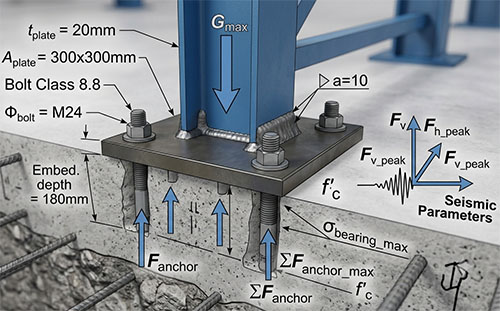
During an earthquake, horizontal ground movement generates overturning forces at the base of the rack. Properly designed anchor bolts transfer these forces into the reinforced concrete floor, helping prevent sliding, uplift, and overturning.
Selecting the correct anchor type involves more than simply choosing a larger bolt. Engineers evaluate factors such as:
- Concrete strength
- Slab thickness
- Anchor spacing
- Edge distances
- Expected seismic loads
- Installation methods
Improper anchoring can significantly reduce the overall seismic capacity of an otherwise well-designed storage system.
2. Reinforced Upright Frames
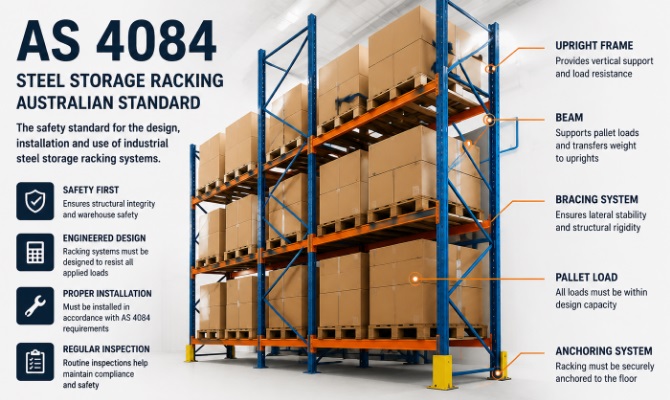
The upright frame forms the primary load-bearing structure of a pallet rack.
Under seismic loading, uprights must resist both vertical pallet loads and substantial horizontal forces generated by ground motion.
To improve structural performance, engineers may specify:
- Higher-strength steel
- Optimized upright profiles
- Increased column thickness
- Reinforced frame bracing
- Larger base plates
However, stronger steel alone does not guarantee better seismic performance. The complete frame geometry and connection details are equally important in determining how forces are distributed throughout the structure.
3. Safety Locking Beam Connectors
Beam connections are subjected to repeated loading during seismic events.
Without positive locking devices, beams may gradually lift from their connectors as the rack vibrates, increasing the risk of beam disengagement and pallet collapse.
Modern seismic rack systems typically incorporate mechanical safety locks that secure beam connectors to the upright frames, helping maintain structural integrity even under repeated cyclic loading.
Although these locking devices are relatively small components, they play an important role in preventing progressive structural failure.
4. Horizontal and Diagonal Bracing
Bracing improves the overall stiffness of the rack system and helps distribute seismic forces throughout the structure.
Horizontal bracing enhances stability between adjacent frames, while diagonal bracing reduces lateral deformation by transferring loads more efficiently.
Depending on the warehouse layout and seismic requirements, engineers may introduce additional bracing in selected rack bays or throughout an entire installation.
Proper bracing not only increases structural rigidity but also reduces stress concentrations that could otherwise develop in individual components during an earthquake.
5. Proper Load Distribution
Even a well-designed seismic rack can perform poorly if inventory is stored incorrectly.
Uneven loading increases the overturning moment acting on the rack and may significantly reduce its stability during seismic events.
Warehouse operators should follow several basic practices:
- Store the heaviest pallets on lower beam levels whenever possible.
- Distribute pallet loads evenly across each beam level.
- Avoid placing concentrated loads on one side of a rack bay.
- Never exceed the manufacturer's rated load capacity.
- Replace damaged pallets before storage.
- Remove severely damaged rack components from service immediately.
Good operational practices are just as important as sound engineering in maintaining long-term seismic safety.
6. Professional Installation and Regular Inspection
Even the most carefully engineered rack system can fail if it is installed incorrectly.
Common installation problems include:
- Missing anchor bolts
- Loose beam locks
- Incorrect bolt torque
- Misaligned upright frames
- Uneven floor contact
- Unauthorized field modifications
These issues may not affect daily warehouse operations, but they can significantly reduce seismic performance when an earthquake occurs.
Routine inspections are therefore essential throughout the service life of the storage system.
Warehouse managers should periodically check for:
- Bent uprights
- Damaged beam connectors
- Loose anchors
- Corrosion
- Missing safety locks
- Forklift impact damage
Any damaged structural components should be repaired or replaced before the rack is returned to service.
Seismic Performance Depends on the Entire System
One of the biggest misconceptions in the warehouse industry is that seismic resistance can be achieved by upgrading a single component, such as using thicker steel or installing larger anchor bolts.
In reality, seismic performance depends on how the entire storage system works together.
A rack with strong uprights but poor beam connections may still experience beam disengagement during an earthquake. Likewise, high-quality anchors cannot compensate for overloaded beam levels or damaged structural members.
Effective seismic design requires engineers to evaluate every element of the storage system, including:
- Rack geometry
- Load distribution
- Beam connections
- Upright frame strength
- Bracing configuration
- Floor anchorage
- Building interaction
- Installation quality
- Long-term maintenance
Only when these factors are considered as an integrated engineering system can warehouse racking provide reliable performance under seismic loading.
For buyers, this means that the quality of engineering support is often just as important as the quality of the steel itself.
Questions to Ask Before Purchasing Seismic Warehouse Racking
Selecting a seismic warehouse racking system involves much more than comparing prices or load capacities. Because seismic performance depends on engineering calculations and project-specific conditions, buyers should evaluate a supplier's technical capabilities as carefully as the product itself.
Before placing an order, consider asking the following questions.
Which Seismic Design Standard Was Used?
Ask which engineering standard the rack system has been designed to follow.
Depending on the project location, this may include ANSI MH16.1, ASCE 7, EN 16681, FEM 10.2.08, or other applicable building codes.
A professional supplier should clearly explain which standards were applied and why they are appropriate for your project.
What Seismic Design Acceleration Was Considered?
Instead of asking whether the rack can withstand a certain earthquake magnitude, ask for the design Peak Ground Acceleration (PGA).
The supplier should be able to identify the design acceleration used during structural analysis and explain how it relates to your warehouse location.
Can Structural Calculations Be Provided?
Engineering calculations demonstrate that the rack system has been analyzed rather than simply copied from a previous project.
Depending on local regulations, calculations may include:
- Load combinations
- Frame analysis
- Beam deflection
- Anchor forces
- Stability verification
- Safety factors
For large warehouses or government projects, structural calculations are often mandatory.
Is the Anchor System Included in the Engineering Design?
Anchor bolts are an integral part of the seismic system rather than optional accessories.
Confirm that the supplier specifies:
- Anchor type
- Anchor size
- Installation depth
- Bolt quantity
- Concrete requirements
- Installation instructions
Proper anchoring is essential for achieving the expected seismic performance.
Are Rack Layout Drawings Available?
A professional supplier should provide detailed layout drawings showing:
- Rack dimensions
- Aisle widths
- Beam elevations
- Upright loc
-
-
PRODUCTS
-
NEWS
-
FOLLOW US
-


 link:
Spieth Medical
link:
Spieth Medical


 if you have questions or suggestions,please leave us a message,we will reply you as soon as we can



-

-
 +86 18006010205
 -
 +86 18006010205
 0
0