 [email protected]
 +86 18006010205



-
Spieth, Space solutionsMore Than 18 Years Manufacturing & Exporting
-
 Time:6/24/2026
 -
 Time:6/23/2026
-
 Tel : +86 18006010205
-
 E-mail : [email protected]
-
 Address : Tongan Park, Tongan District, Xiamen, China 361023
What Is Pallet Racking Beam Weight Capacity
 Time:5/12/2026
 141
141
Pallet racking beam weight capacity is the maximum load that a pair of horizontal beams in a pallet racking system can safely support when goods are evenly distributed across them. It is usually expressed as uniformly distributed load (UDL) and is determined by beam span, steel thickness, and rack design.
In warehouse engineering, this value is not just a number—it directly affects storage safety, rack stability, and forklift operation safety.
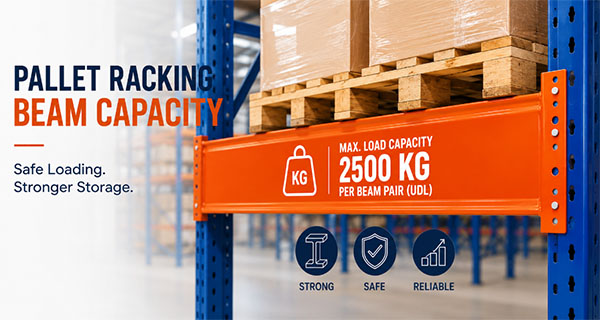
What does pallet racking beam weight capacity mean in warehouse design?
In real warehouse applications, beam capacity defines how much palletized cargo can be stored per level without causing excessive bending or structural stress. It is a key parameter used by engineers when designing pallet racking layouts.
Unlike simple weight limits, beam capacity must consider both static load (stored pallets) and dynamic influence from forklift handling.
This is why two beams with the same size may still have different rated capacities depending on the rack system and connection design.
Why pallet racking beam weight capacity is critical for warehouse safety
Incorrect beam loading is one of the most common causes of rack deformation and structural failure in industrial warehouses.
- Prevents beam bending and long-term deformation
- Maintains safe pallet storage conditions
- Reduces risk of rack collapse under overload
- Improves forklift handling stability
- Ensures compliance with warehouse safety standards (FEM / RMI)
From an operational perspective, beam capacity also determines how efficiently a warehouse can utilize vertical space without compromising safety.
Engineering logic behind beam weight capacity
Beam capacity is not randomly assigned. It is based on structural mechanics, especially how steel behaves under bending stress.
The most common assumption in pallet racking design is uniformly distributed load (UDL), meaning the load is evenly spread across the beam length rather than concentrated at one point.
When load increases, the beam begins to deflect. Engineers limit this deflection to ensure:
- The beam does not permanently deform
- Pallets remain stable during storage
- Load distribution remains predictable
This is why beam span, steel grade, and profile shape directly affect final load capacity.
Typical pallet racking beam weight capacity range
Although exact capacity depends on design, most industrial pallet racking systems fall within these ranges:
- Light-duty racking: 500 – 1,500 kg per beam pair
- Medium-duty racking: 1,500 – 3,000 kg per beam pair
- Heavy-duty racking: 3,000 – 5,000+ kg per beam pair
In real projects, engineers always design with a safety margin instead of using the maximum theoretical value.
Key factors that influence beam load capacity
Beam span and rack width
A longer beam span increases bending stress, which reduces overall load capacity even if steel thickness remains the same.
Steel strength and profile design
Box beams generally provide higher rigidity compared to step beams due to closed-section structure.
Load type and pallet distribution
Uneven pallet placement can significantly reduce real usable capacity even if nominal rating is high.
Rack system compatibility
Beam and upright compatibility ensures force is transferred correctly through the racking structure.
How pallet racking beam weight capacity is calculated in engineering
Pallet racking beam capacity is determined through structural engineering principles rather than simple weight estimation. The goal is to ensure the beam can withstand both static pallet load and long-term stress deformation.
In most warehouse racking systems, engineers evaluate beam performance based on bending stress, steel elasticity, and allowable deflection limits.
The most commonly used assumption is Uniformly Distributed Load (UDL), where load is evenly applied across the beam span.
Beam deflection and why it matters
Deflection refers to how much a beam bends when load is applied. Even if the beam does not break, excessive deflection can still make the racking unsafe.
In industrial warehouse design, deflection is strictly controlled to ensure:
- Pallet stability during storage
- Consistent load distribution across beams
- Long-term structural integrity of racking systems
This is why two beams with identical steel thickness may still have different safe load ratings depending on span length and structural design.
Simplified engineering logic behind beam capacity
Beam capacity is influenced by three core engineering factors:
- Bending moment: increases with longer beam span
- Material strength: high-grade steel improves load resistance
- Moment of inertia: depends on beam profile shape
Among these, beam span has the most direct impact on capacity reduction. Even a small increase in span can significantly reduce allowable load.
Real warehouse example of pallet racking beam loading
In a typical warehouse distribution center, a medium-duty pallet racking system may store 1,000–1,200 kg pallets across multiple beam levels.
For example, if each beam level supports 2 pallets of 1,000 kg each, the total load per beam pair is 2,000 kg under evenly distributed conditions.
However, if pallets are not evenly placed, localized stress increases and the real safe capacity can be significantly reduced.
This is why engineers always recommend leaving a safety margin of 20%–30% in real warehouse operations.
Common misunderstanding about beam weight capacity
Many warehouse operators assume that beam capacity is a fixed value, but in reality it depends on system configuration.
- Beam rating is based on ideal load distribution
- Real warehouse loading is often uneven
- Forklift impact adds dynamic stress
- Long-term fatigue reduces structural performance
Because of these variables, the actual safe operating load is often lower than the theoretical capacity listed by manufacturers.
LSI keywords applied in this section
This article is also optimized for related search terms such as:
- warehouse racking load capacity
- pallet rack beam deflection
- industrial storage system design
- heavy duty pallet racking load rating
- warehouse safety load limits
How to choose the right pallet racking beam capacity
Selecting the correct beam capacity is not only about matching weight. It is about ensuring long-term warehouse safety and operational stability.
- Calculate maximum pallet weight per level
- Consider pallet quantity per beam span
- Evaluate forklift loading method and impact force
- Include future expansion margin
- Check compatibility with upright frame system
In industrial warehouse projects, engineers usually recommend designing with at least 20% safety buffer above expected load.
Common mistakes in pallet racking beam load design
- Ignoring uneven pallet weight distribution
- Using theoretical capacity instead of real load conditions
- Mixing different rack systems or brands
- Not considering forklift impact loads
- Overlooking long-term structural fatigue
These mistakes often lead to premature beam deformation or reduced rack lifespan in real warehouse operations.
Safety standards for pallet racking beam weight capacity
Warehouse racking systems should always follow recognized safety standards such as:
- FEM (European Federation of Materials Handling)
- RMI (Rack Manufacturers Institute – USA)
- ISO warehouse safety guidelines
- Manufacturer load charts and certification documents
Regular inspection and maintenance are also required to ensure long-term structural safety.
People Also Ask (FAQ)
What is pallet racking beam weight capacity?
It is the maximum load a pair of pallet racking beams can safely support under evenly distributed loading conditions.
What affects pallet racking beam capacity?
Beam span, steel thickness, material grade, load distribution, and rack system design all directly affect capacity.
Is beam capacity fixed or adjustable?
It is fixed for a given design, but can be increased by changing beam type, reducing span, or upgrading the rack system.
What is a safe pallet racking load practice?
Always follow manufacturer load charts and include a safety margin of 20%–30% below maximum rated capacity.
Need a customized pallet racking solution?
If you are planning a warehouse project or need help calculating the correct pallet racking beam weight capacity, our engineering team can provide a tailored solution based on your storage requirements.
We support custom warehouse racking design, load calculation, and full system planning for industrial storage projects.
Contact us for a professional racking layout recommendation.
-
-
PRODUCTS
-
NEWS
-
FOLLOW US
-


 link:
Spieth Medical
link:
Spieth Medical


 if you have questions or suggestions,please leave us a message,we will reply you as soon as we can



-

-
 +86 18006010205
 -
 +86 18006010205
 0
0